Search for “voodoo love magic and reconciliation” and you will land on pages full of words nobody explains. Lwa. Veve. Service. Crossroads. Mojo. A page tells you that Erzulie will “open the road” to your ex, and you are left wondering who Erzulie is, what a road has to do with a breakup, and whether any of it is real or just atmosphere.
This guide fixes that. It defines the terms one at a time, says where each one comes from, and shows how it connects to the practical question behind your search: can this kind of work help two people who were close find their way back to each other?
It also sorts the practice from the movie version. Most of what people think they know about voodoo came from films, souvenir shops and old newspaper panic, and almost none of it describes how the traditions work. We will go through the main myths, say what is true instead, and then look at what reconciliation work can and cannot do, including the awkward cases: an ex who has moved on, a long distance, a stretch of no contact.
One thing up front. Baba Ali Musa’s practice comes from a Senegalese ancestral lineage. The vocabulary in this guide comes largely from Haitian Vodou and Louisiana Voodoo, which are related to that lineage through shared West African roots but are separate traditions with their own priesthoods. We explain these words so you can read other sources with your eyes open, not because Baba Ali is borrowing another house’s spirits. If you want the history of how it all arrived in America, that is a different article: the history of voodoo love magic in New Orleans covers Congo Square, the Haitian refugees and Marie Laveau. This one is a vocabulary and use-case guide. Read that one for the story, this one for the meaning of the words.
What “voodoo love magic and reconciliation” actually means
Take the phrase apart. “Voodoo” is the everyday English word for a family of African-rooted spiritual traditions, and it is used loosely, sometimes for a religion, sometimes for a folk-magic habit, sometimes for nothing more than a mood. “Love magic” is practical spiritual work aimed at a relationship: drawing someone toward you, protecting a bond, softening a quarrel, clearing something that is standing between two people. “Reconciliation” narrows it further. It means work for a relationship that already existed and has gone cold, broken or silent, so the goal is repair, not a first spark.
Put together, the phrase describes a very old idea: that a damaged bond can be tended through prayer, offerings, symbolic acts and the help of ancestors or spirits, alongside whatever you do in the ordinary world. In the traditions behind the phrase, nobody treats this as a replacement for apologies, honest talk or time. They treat it as a companion to those things, and sometimes as the thing that makes a person ready to attempt them.
That is worth saying plainly because search results often blur two different promises. One is “a spiritual practitioner will do work on your behalf and you will watch for changes.” The other is “a spell will make a person do what you want.” The first is what the traditions describe. The second is the film version, and no honest practitioner can offer it. If you want the longer argument about consent, our article on love spells and free will takes it on directly.
Four words people mix up: Vodun, Vodou, Voodoo and Hoodoo
Before the vocabulary, the names of the traditions themselves, because writers use them interchangeably and they should not.
- Vodun
- The older religion of the Fon, Ewe and neighboring peoples of what is now Benin and Togo. The word means “spirit” or “the divine.” It is practiced openly there today.
- Vodou
- The Haitian religion that grew out of Vodun and other African traditions under slavery, mixed with Catholic imagery. It has priests, temples, initiation and a large body of song. This is where words like lwa and veve belong.
- Voodoo
- Usually Louisiana Voodoo, formed in New Orleans from African, Haitian, French and Catholic influences. It is also simply the common English spelling people use for all of the above.
- Hoodoo
- African American folk magic from the American South, also called rootwork or conjure. It is a set of practices, not a religion, and many people who use it are Christian.
Most of the “voodoo love spells” sold online are really Hoodoo or general folk magic wearing Vodou vocabulary. That is not a criticism by itself, since traditions have always borrowed from each other, but it helps to know which one you are reading. Our guide What Is Voodoo? goes into the family tree, and the post on voodoo, hoodoo and santeria compares them side by side. For the scholarly record on dates and practice, the Haitian Vodou entry (Wikipedia, with references to ethnographic sources) is a fair starting point.
The vocabulary, one term at a time
Here are the words you will meet most often on pages about voodoo love magic and reconciliation. Each one gets its meaning in the tradition it comes from, then a short note on how it tends to show up in love and repair work.
Bondye
In Haitian Vodou, Bondye is the creator, from the French Bon Dieu, “good God.” Bondye is real but distant, which is why people direct their daily prayers and offerings to the spirits instead. If a page talks about a spell “overriding” or “commanding” Bondye, it has misread the tradition. Nobody orders the creator around.
Lwa (also spelled loa)
The lwa are the spirits people actually work with in Haitian Vodou. Each has a personality, a domain, favorite colors and foods, and a temperament. They are grouped into families, or nations, such as Rada (generally seen as cooler and gentler, rooted in Dahomey) and Petwo (hotter, forged in the Caribbean). A lwa is not a genie. You do not summon one to do a task and send it away. The relationship runs both directions: you give attention and offerings, and in return you may receive guidance, protection or help. In love work, a page that says “the lwa will do X to your ex” is skipping the part of the tradition that says the lwa has its own will, too.
Erzulie Freda
Erzulie Freda (also Ezili Freda) is the lwa most people mean when they say “the voodoo goddess of love.” She governs love, beauty, luxury, flowers and longing. Descriptions in the tradition show her as elegant, flirtatious and hard to satisfy, and she is famous for ending ceremonies in tears because what she wants is never quite enough. That detail matters more than it seems. She is not a vending machine for romance. She is a spirit of desire and its ache, and people who bring her a breakup are bringing it to the one spirit who understands wanting something that has slipped away. Our guide Erzulie Freda and Love covers her story, her colors and her sisters, Erzulie Dantor and Ge-Rouge, in full.
Houngan and mambo
A houngan is a Vodou priest and a mambo is a priestess. They are initiated, trained within a house (an ounfò), and responsible for ceremonies, healing and the care of a community. The word matters because it shows how much training sits behind the real thing. A website where someone calls themselves a houngan after reading a few books is not describing the same role. That is one reason this site is plain about what Baba Ali Musa’s lineage is, and what it is not.
Service and offerings
In Vodou, people “serve” the lwa. Service means giving the spirit what it likes: food, drink, perfume, flowers, candles, song. For Erzulie Freda the traditional gifts include perfume, sweet cakes, flowers and fine things. An offering is not a payment that triggers a result. It is closer to hosting a guest, or keeping up a friendship, where you give regularly and do not only show up when you need something. This is also why a single offering with a request attached, from a stranger, rarely resembles real service.
Veve
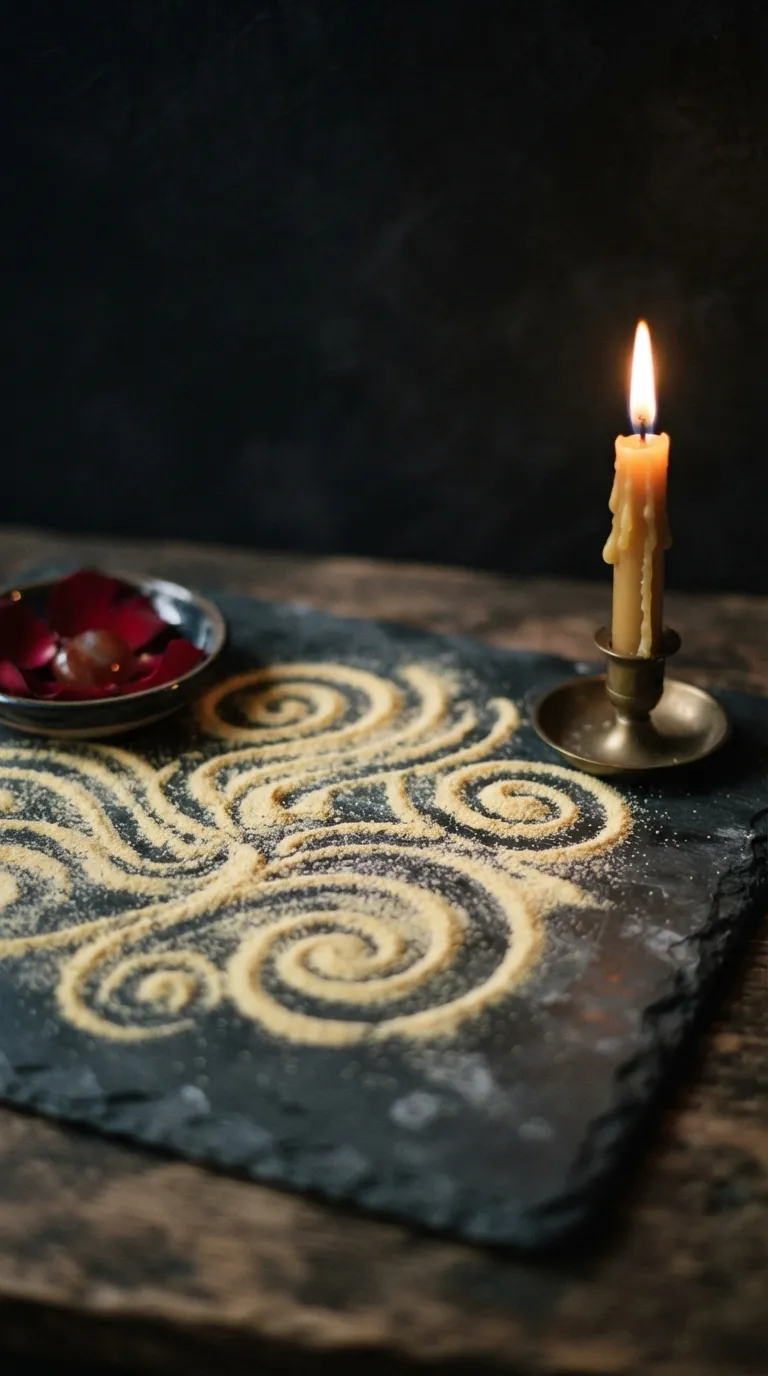
A veve (also vèvè) is a ground drawing made for a particular lwa, traditionally with cornmeal, flour or ash, dusted onto the floor of a ceremony. Each lwa has its own design, and Erzulie Freda’s is built around hearts. The drawing works as a doorway or address: it marks where the spirit is being welcomed. It is not meant to last. It gets scuffed away by dancing feet and swept up afterward. For more detail on how veves are made and read, the veve entry (Wikipedia) cites the main studies.
Two cautions. First, veves are sacred marks inside a living religion, so copying them as decoration or tattooing one onto a love spell kit is closer to wearing someone else’s wedding ring than to wearing a lucky charm. Second, a printed veve on a candle label does nothing the tradition would recognize. The meaning comes from the ceremony around it.
The crossroads
In Haitian Vodou, Papa Legba is the keeper of the gate and the first spirit greeted in most ceremonies, because nothing else opens without him. Crossroads show up in Yoruba tradition (Eshu and Elegba), in Southern Hoodoo and in West African life generally, as a meeting place of paths and a spot for decisions. In love work the crossroads is easy to picture: two people stand at a point where the relationship could go one way or another. Our guide The Crossroads in Tradition follows the idea across all of those cultures. The key lesson carries into reconciliation: a crossroads is where a choice is made, and the choice is not yours alone.
Gris-gris, mojo and the charm bag
Gris-gris (pronounced “gree-gree”) is a Louisiana word of West African origin for a small charm bag carrying herbs, roots or written prayers, made to protect or attract. Mojo is its Hoodoo cousin, often called a mojo hand or bag. In love work they are tools for focus and carry-along reminders, closer to a rosary or a worn talisman than to a switch. The gris-gris entry (Wikipedia) traces the word. Our spell ingredients glossary lists common herbs and materials and what they mean.
Dolls and poppets
The doll is the most misunderstood object in the whole subject. In practice a doll or poppet is a focus: something small to hold a person’s name and an intention, used for prayer, healing or sweetening. Pins and harm belong mostly to film. Our post on what a voodoo doll is goes into this, and the voodoo doll love ritual shows how Baba Ali actually uses one: as a focus for a warm, reconciling intention, not for harm.
Baron Samedi and the Gede
The Gede are the lwa of death and the dead, known for humor, bawdy songs and a strong hold on life. Baron Samedi, their best-known figure, appears in Hollywood as a sinister villain. In the tradition, the Gede are the ones who stand at the crossroads between living and dead, and they have a reputation for being fiercely pro-life. They are not a love spirit and do not belong in a reconciliation story at all, which is a good test of a page’s reliability: if it brings Baron Samedi into your breakup, it is reaching for atmosphere.
Voodoo love magic and reconciliation: what each term does in a repair
With the words in hand, a pattern shows up. Most of this vocabulary describes ways of tending a relationship, with a person, a spirit or a community. That same logic carries over when two people are trying to find their way back to each other. The table below maps the vocabulary to what actually happens in the work.
| Term | In its tradition | What it means for reconciliation |
|---|---|---|
| Lwa | A spirit with its own will, approached through relationship | Help is requested, not ordered. The same goes for the other person: their choice stays theirs. |
| Erzulie Freda | The spirit of love, beauty and longing | Longing is treated as real and respected, not shamed. The ache is part of the work. |
| Offering | Gifts that keep a relationship with a spirit healthy | You also give effort: patience, honesty, time. Sweetening work such as honey is a symbol of softening, not payment. |
| Veve | A ground drawing that marks where a spirit is welcomed | A reminder that the work begins by opening a way, not by pushing through a closed door. |
| Crossroads | A meeting of paths and a place of decision | Both people stand at a choice. Work can clear the road; it cannot walk it for them. |
| Houngan / mambo | A trained, initiated priest or priestess | Ask any practitioner who trained them and in what lineage. A clear answer is a good sign. |
| Gris-gris / mojo | A charm bag for protection or attraction | A focus object you keep close, like a prayer card, to steady your own intention. |
Notice what is missing from the right-hand column: “controls,” “commands,” “makes.” That is deliberate. The traditions behind these words are built around relationship and exchange. They describe asking, giving, waiting and receiving. When someone sells reconciliation as an order that a spirit will carry out against the other person’s inclination, they have swapped the tradition for the movie.
Hollywood myths, and what the practice looks like instead
Almost everything people believe about voodoo love magic traces to a handful of films and a few early twentieth-century travel books. The zombie, for example, comes from Haitian folklore about a person said to be reduced to a servant by a sorcerer, which writers such as W. B. Seabrook sensationalized in the late 1920s, and films such as White Zombie (1932) cemented. It is not a religious practice (Wikipedia’s zombie entry traces the history). Here are the myths that matter most for love work.
Myth: sticking pins in a doll makes someone fall in love or suffer
Pins in dolls are largely a product of movies and souvenir shops. Dolls and poppets do appear in some practices, usually as a focus for prayer on a person’s behalf. Used for love or reconciliation, a doll might be wrapped in cloth, tied with cord and kept with a candle. The aim is warmth, not pain.
A love spell turns someone into a devoted puppet
The film version has a person suddenly obsessed, dazed and unable to resist. Nothing in the tradition describes that. What practitioners describe instead is gentler and slower: a softened mood, an opened door, a message that arrives, a memory that returns. A person who returns after a spell is still a person, with a mind of their own, and whether the relationship works afterward depends on the two of them, not on any ritual.
Voodoo is dark, evil magic
Voodoo has no devil figure. Haitian Vodou teaches a good creator, a family of spirits, reverence for ancestors and a commitment to community. Healing, protection, luck and love are the day-to-day business. Harmful practices exist in every spiritual culture, and the stereotypes about voodoo were used for generations to belittle Haiti and Black religion more broadly. Our post on white magic versus black magic in love spells explains where the labels came from and why they mislead.
Possession is frightening and constant
In Haitian Vodou, a lwa may “mount” a devotee during a ceremony, speaking through that person to give guidance or blessings. Within the house, that is understood and welcomed, and the person is cared for. In films it becomes a horror scene. It also is not part of a consultation, a reading or a reconciliation case. You will not be asked to take part in anything of the kind.
A famous name means a better result
Many sites trade on Marie Laveau, Papa Legba or Erzulie as brand names. Using a name does not make the work genuine, and it says nothing about the lineage of the person using it. The better questions are: what do they actually do, how do they describe results, and do they explain their limits?
One candle or one night is all it takes
Quick-fix packages are common online because people in pain want speed. Real repair has a pace. A quarrel that took weeks to harden will rarely dissolve overnight, and honest practitioners describe signs unfolding over days, then the real work of repair over weeks. The post on how long a love spell takes to work sets out realistic timelines.
Where Baba Ali’s practice fits among these terms
To avoid confusion, here is a direct statement. Baba Ali Musa is not a Haitian houngan, and this site does not say he serves Erzulie or any lwa. His practice is a Senegalese ancestral lineage that he has worked in for more than thirty years: prayer, ancestral guidance, candles, honey and sweetening, cord and knot work, cleansing baths and clear counsel. West African traditions share deep roots, which is why the vocabulary overlaps in places and why Haitian Vodou, Louisiana Voodoo and a Senegalese lineage can all be described as relatives. They are not interchangeable, and each deserves to be named correctly.
In practice, when a client comes to Baba Ali about reconciliation, the “terms” show up in other forms. The crossroads becomes the question of where the relationship stands and what is blocking it. Offerings become the candle and the sweetening work, plus the small disciplines asked of the client. The lwa-equivalent is the ancestral guidance he draws on. Our voodoo love spells service describes how this work runs in general, and the reconciliation spell page covers the repair-specific version: a free reading first, a plan based on how things ended, and aftercare for the weeks that follow.
If you are specifically drawn to Erzulie Freda or to Haitian Vodou, the respectful route is to find a Vodou house and learn from a houngan or mambo there. A blog post, including this one, cannot give you that, and a ritual copied from a website is not the same as service within a house. That is why our Erzulie guide says it was written “with respect for Haitian Vodou” and sends readers onward to real teachers.
Reconciliation, step by step, in this vocabulary

Here is how a typical reconciliation consultation tends to flow, using the terms above as the map. This is the shape of the work, not a script, and every case adjusts.
- The reading. It begins with listening. How did the relationship end, who ended it, what was said, and what is happening now? This is the crossroads question: where does each person stand, and what is in the way? A reading looks at history and current attachment, not only at what you wish would happen. Our love reading consultation is the usual starting point.
- Naming the obstacle. Some breakups are about hurt and pride. Some involve a third person, a family objection or a long silence. Naming the obstacle decides which kind of work fits. For interference, clearing third-party interference is its own service. For cooled-off hurt, healing a broken relationship may fit better.
- The work itself. Candles, honey, cord, prayer and ancestral guidance, timed and directed at the bond. This is the closest equivalent to offerings and service: gifts of attention and symbol meant to soften what has hardened.
- Your part. The traditions say a relationship runs both ways, and so does this. You are usually asked to hold back from the behavior that would undo the work: repeated messages, angry posts, testing the other person. Often that means a short period of calm and silence.
- Watching for signs. The first signs are usually small: a view, a like, a short message, a softer tone, an unblocked number. They are signals, not a verdict. Our post on signs a love spell is working lists them honestly, including the signs that are just wishful thinking.
- Aftercare. If contact reopens, the question becomes what you do with it. Repair needs honest conversation and changed habits. Work can open a door, and what you do on the other side decides how long it stays open. See what to do after a love spell is cast.
Baba Ali’s view, after more than thirty years in this work, is that reconciliation succeeds or fails mostly in that last step. The spiritual part can ease the way back. It cannot rebuild trust by itself.
The hard cases: moved on, long distance, no contact
This is where competing pages go quiet, so it gets space here. Across the pages we reviewed while researching this topic, none dealt honestly with what to do when the situation is difficult. That is the part readers most need.
When your ex has moved on
If your ex is in a new relationship, reconciliation work faces a bigger obstacle. A new attachment may be shallow, or it may be serious, and a reading helps tell them apart. Work is sometimes directed at clearing confusion and leaving the door open without attacking the new partner, which is neither fair nor effective. If the new relationship is solid and your ex is content, the honest answer may be that now is not the time, and that the best use of energy is healing yourself. We cover this in detail in reconciliation when an ex has moved on.
When you live far apart
Distance does not stop spiritual work, since it addresses the bond rather than physical closeness. What it changes is the practical side: contact is harder to arrange, small gestures are harder to make, and misreading is easier. The long-distance love spell service is built for exactly that situation, and our post on love spells for long-distance relationships goes into the details.
When there has been no contact
No contact is often misread as a failure. It can be healthy: a pause that lets feelings settle. Work is often timed around it, and breaking silence in the wrong moment can undo progress. The post on no contact and love spells explains how it fits, and how to reopen communication after no contact covers the first message, which matters more than most people expect.
When the other person has said no
If someone has clearly and repeatedly said they want no contact, that answer deserves respect. No tradition worth following teaches otherwise. Spiritual work can help you grieve, steady yourself and be ready if circumstances change. It should never become a way around a person’s refusal. If a relationship involved fear, threats, stalking or violence, please do not try to reconnect with that person through any means, spiritual or otherwise. The National Domestic Violence Hotline (1-800-799-7233) offers free, confidential support at any hour.
How to read any voodoo love page without being fooled

Now that you know the vocabulary, you can use it to test a page. Here are the red flags that matter most when a practitioner’s site uses these terms.
- Terms used as brand names. If Erzulie, Legba or Marie Laveau appear in every heading with no explanation of who they are, the words are decoration.
- Control language. Phrases like “he will have no choice” or “she will crawl back” describe the movie version, not the tradition.
- No lineage stated. A real practitioner can say who taught them and in what tradition. A vague “ancient secret” is not an answer.
- Fixed outcomes and fixed prices. No one can promise a particular result on a particular date.
- Invented testimonials. Perfect five-star stories with no detail are easy to fake.
- Pressure to pay more. A repeating pattern of “your case needs extra work” is a classic scam sign.
- Sacred marks as clip art. Veves pasted on a banner suggest the writer has not studied them.
Our guide to scam warning signs expands on this list, and the post on how to choose a real love spell caster shows what to ask before you pay. A good practitioner is comfortable with questions, names what he or she does and does not do, and explains limits in plain language.
Baba Ali’s own commitments are written down. The work is done with consent in mind and never pressures anyone, and no practitioner can promise a fixed result. The one promise attached to the service is financial: Money-back guarantee: no change within 7 days, full refund. That covers what you paid, and it is a statement about the service, not a claim about what another person will choose.
How to prepare before you speak with anyone
Whether you book a reading or simply think it over, a few steps will help, and none of them require belief in anything.
- Write the timeline. Jot down how the relationship started, how it ended and the last contact, with dates. Facts calm the mind and help any reader or practitioner.
- Name your own part. What would you do differently? Reconciliation works when both sides can say that honestly, even privately.
- Decide what you actually want. The person, or the feeling of not being lonely? The answers lead to different work, and a good reading will ask.
- Pause the loud behavior. No repeated messages, no testing, no late-night posts. It is hard, and it protects what you are trying to repair.
- Prepare for the answer you do not want. A good consultation can tell you that the road is closed for now. That is useful information, not a failure.
Our guide how to prepare for a consultation adds a checklist you can bring.
Why the terms matter more than the spells
It is easy to treat vocabulary as trivia. It is not. When you know what a lwa is, you stop expecting one to follow orders. When you know what a veve is, you spot a counterfeit. When you know the crossroads is a place of choice, you understand why a person you love has to take the road themselves. Each term is a small correction to the movie version, and together they turn “voodoo love magic and reconciliation” from a mystery into something you can evaluate.
The deeper point is that these traditions are about relationship. A relationship with a spirit, an ancestor, a community, a partner. They ask for patience, regular attention and honesty, and they place choice at the center. That is what repairs most breakups too. So when you read a page that treats reconciliation as a mechanical order, you can be fairly confident it is not describing the traditions it names.
If you want help with your own situation, the return lost lover spell and reconciliation spell pages explain what each service covers, and Baba Ali offers a free reading to start. For the longer tour of the topic, reconciliation spells: meaning, approach, process and limitations covers the repair side in depth.
Quick reference: the terms in one place
- Bondye
- The distant creator in Haitian Vodou, from the French Bon Dieu.
- Lwa (loa)
- A spirit with its own personality and will, approached through relationship and offerings.
- Erzulie Freda
- The lwa of love, beauty and longing, famous for weeping at ceremonies.
- Houngan / mambo
- An initiated Vodou priest or priestess, trained within a house.
- Service
- The act of giving a lwa food, drink, flowers, song and attention.
- Veve
- A ground drawing, usually cornmeal or ash, that welcomes a particular lwa.
- Papa Legba
- The keeper of the gate, greeted first so the road can open.
- Crossroads
- A meeting of paths and a place of choice, found across West African and diaspora traditions.
- Gris-gris / mojo
- A small charm bag for protection or attraction, from Louisiana and Hoodoo traditions.
- Reconciliation
- Work aimed at repairing a relationship that already existed, rather than starting a new one.
Questions about voodoo love magic and reconciliation
Is voodoo love magic the same as Haitian Vodou?
No. Haitian Vodou is a full religion with priests, temples and initiation. “Voodoo love magic” usually means folk-magic practice using some of its vocabulary, often mixed with Hoodoo. Baba Ali’s practice comes from a Senegalese ancestral lineage and does not claim to serve the lwa.
What is a lwa, and does it do the work for me?
A lwa is a spirit in Haitian Vodou with its own personality and will. It is approached through relationship and offerings, not commanded. No lwa is an employee who carries out a task, and the same holds for the person you hope will return.
Do I need to know these terms to benefit from reconciliation work?
No. The vocabulary helps you read other sources critically, but a consultation with Baba Ali is plain conversation. You describe what happened, and he explains the plan in everyday language.
Can I draw a veve or make an offering to Erzulie at home?
You can leave flowers or light a candle as a personal gesture of respect. Drawing sacred veves or claiming to serve a lwa belongs within a Vodou house with a houngan or mambo. If you feel called to her tradition, seek that out.
Can this work if my ex has moved on or we live far apart?
Distance does not block spiritual work. A new partner makes the case harder, and a reading will show how serious that attachment is. If your ex is happy and settled, the honest advice may be to wait and focus on yourself.
Does reconciliation work remove my ex’s choice?
No. It does not remove anyone’s choice. It is meant to soften hurt and clear obstacles so that both people can decide with a calmer mind. If someone has clearly said they want no contact, that answer should be respected.
How soon will I see a sign, and what if nothing changes?
Most clients notice a first sign within 3 to 7 days, such as a message or a warmer tone. Full reconciliation takes longer. If nothing changes, you can request a refund under the refund policy.