A breakup does not only hurt the heart. It disturbs sleep, appetite, concentration, and the quiet sense that your life is going somewhere. People who come to Baba Ali after a split often say the same thing in different words: “I do not know who I am without them, and I do not know what to do with my hands.”
Spiritual practice is one answer to that second problem. It gives your hands, your breath and your evenings something steady to do while the grief moves through.
This guide is about spiritual practices after a breakup, meaning gentle, repeatable acts that help you grieve, reflect and settle. It is not a spell, and it is not a way to win anyone back. It is a set of tools from West African ancestral tradition, from older folk practice, and from the contemplative habits people in many faiths have used for centuries. Some are practical (breathing, writing, walking). Some are ritual (a bath, a candle, a glass of water for the ancestors). All of them can be done at home, alone, for little or no money.
You will also find a plain section on when a spiritual practice is not enough and a counselor or doctor should be involved. Both things can be true at once. A person can pray every morning and still need a therapist, and a good practitioner will tell you so.
Why spiritual practice helps when a relationship ends

When a relationship ends, you lose more than a person. You lose a daily routine, a future you had pictured, a witness to your life, and often a shared circle of friends. The mind tries to fill that gap with replaying conversations and checking a phone that stays quiet. That loop wears people out.
Ritual interrupts the loop. A ritual has a beginning, a middle and an end. You light the candle, you say or write what you came to say, you put the candle out. The grief did not disappear, but it was given a place and a time, and that is often enough to let you sleep. In Baba Ali’s practice, people who build even one small ritual into their evening tend to describe the same shift: the pain is still there, but it stops showing up at every hour.
There is also research behind the idea that reflection helps. Studies of people going through romantic breakups have found that recovering a clearer sense of who you are, apart from the relationship, is linked with feeling less emotionally stuck and less lonely afterward. Spiritual practice is one of the oldest ways humans have to ask that question: who am I, what do I value, what do I want to carry forward and what do I want to set down?
A fair word of caution, too. The same body of research shows that how you reflect matters. Writing about a breakup helps some people and not others, and for certain people repeating the story over and over can slow recovery rather than speed it. We come back to that in the journaling section, because it changes how the practice should be done.
Ground rules before you start
A few honest ground rules will make everything below work better.
First, these practices are for you. Do not run them as a disguised attempt to reach your ex or influence their choices. If you are thinking about reconciliation, that is a separate conversation with its own ethics, and we cover it near the end. A grief practice done with one eye on the other person’s phone does not heal anything.
Second, grief has no schedule. Some people feel lighter in three weeks; others in six months. A relationship of two years and a relationship of twenty do not produce the same recovery curve, and neither does a breakup you chose and one that happened to you. If someone tells you that you should be over it by now, they are guessing.
Third, avoid spiritual bypassing. That is the habit of using spiritual language to skip the feelings: “everything happens for a reason,” “I have already forgiven them,” “it was just karma.” Calm that arrives too fast is usually a lid on a pot. Let yourself be angry, sad, relieved or all three in one afternoon. The practices below are meant to hold those feelings, not talk you out of them.
Fourth, keep it small. One practice done every day for two weeks beats seven practices done once. If you try everything in this guide in one weekend, you will be tired and discouraged by Monday. Pick one, maybe two, and start there.
Fifth, keep it safe. Candles stay in sight and on a heatproof surface. Herbs go on skin only after a patch test, and nothing in this guide is meant to be eaten or drunk apart from ordinary water, tea or food you already know agrees with you. If you are pregnant, have sensitive skin, or take medication that affects your skin or blood pressure, check with your doctor before using herbal baths.
Practice one: grounding your body first
Grief lives in the body before it reaches the mind. Racing heart, tight chest, a stomach that will not accept food, hands that will not stop shaking. Grounding is the practice of telling the body, in physical terms, that you are here and you are safe right now. In West African tradition and in many others, the earth itself is part of that conversation. You do not need to believe anything for it to work.
A five-minute breath
Sit with your feet flat on the floor. Place one hand on your chest and one on your belly. Breathe in through your nose for a count of four, then out through your mouth for a count of six. The longer exhale is the point: it nudges the body toward its resting state. Repeat for five minutes. If your mind wanders to the breakup, that is normal. Notice it, then come back to the count.
The five senses check
When a wave of panic or longing hits, name five things you can see, four you can touch, three you can hear, two you can smell and one you can taste. It sounds too simple. It works because it pulls attention out of the story and into the room.
Bare feet and open air
If you have a patch of grass, soil or even a bare porch step, stand on it barefoot for a few minutes in the morning. Put your hands on the bark of a tree if one is nearby. The old teaching is that the earth holds what we cannot carry. The practical effect is that you are outside, breathing, and not staring at a screen.
Cold water and warm water
Run cold water over your wrists or splash your face when you feel overwhelmed. Drink a full glass of water slowly, with attention, before anything else in the morning. Water is the central element in many cleansing traditions, and in the first weeks after a breakup, simply remembering to drink it is a small spiritual act of self-care.
Practice two: a cleansing bath for the heavy days

Many people describe the first days after a breakup as feeling dirty or heavy, as if the hurt were sitting on the skin. A cleansing bath is one of the oldest answers to that feeling, and it is a staple of the tradition Baba Ali practices. The idea is simple. Water carries away what you no longer want to hold. You are not washing the other person off. You are washing off the weight of the last few days.
The full recipes, herb lists and safety notes live in our cleansing baths guide, so we will not repeat them here. What follows is the reflective side: how to use the bath as a practice for grief rather than a quick fix.
A simple way to do it
Choose a time when you will not be interrupted, ideally in the evening. Prepare the water however the guide describes, or keep it plainer still: warm water and a spoonful of sea salt. Before you step in, decide what you are setting down. It might be the argument, the waiting, the anger, the version of yourself who kept begging. Say it quietly or in your head. As you wash, imagine each thing leaving with the water. When you finish, let the water drain while you stay with the thought, “this is leaving me.” Dry yourself, dress in clean, comfortable clothes, and drink a glass of water.
If you do not have a bathtub
A basin of warm water for the feet and hands works. So does a shower with the same intention. The ritual lives in the attention, not the equipment.
Cleansing the space as well
Many people also want to clear the home. Open the windows. Wash the floors, working from the back of the house toward the door. Put away or box up the objects that hit you in the stomach every time you see them: the photo frame, the hoodie, the gift still in its wrapping. You do not have to throw anything out. Boxing something and putting it on a high shelf is a perfectly respectable ritual. If your home feels stuck, heavy or unsettled in a way ordinary tidying does not fix, a spiritual uncrossing and cleansing session is the next step Baba Ali offers, and it is meant for exactly that situation.
How often
Once a week is plenty. More than that and the bath becomes a way of avoiding feelings rather than moving them. If you find yourself needing a ritual bath every night, that is a signal worth listening to. It may mean you need more support than ritual alone can give, which we discuss near the end.
Practice three: journaling as reflection, not rumination

Writing is the most accessible spiritual practice there is. A pen, a notebook, ten minutes. In many traditions, writing a prayer, a name or a question is itself a ritual act. After a breakup it does something practical too: it moves the loop in your head onto paper, where you can look at it from the outside.
Here is the caution mentioned earlier. A well-known study by David Sbarra and colleagues, published in Clinical Psychological Science, tested expressive writing with people going through a marital separation. Contrary to what many expected, the writing group did not recover faster, and the researchers reported that it could slow emotional recovery for some participants. The takeaway is not “do not write.” It is that writing which only retells the pain, again and again, can keep the wound open. Reflection needs a direction.
Journaling with a direction
Use short, structured sessions. Set a timer for ten to fifteen minutes. Start with one honest paragraph about how you feel right now, then turn the page and answer one question from the list below. When the timer ends, stop. Close the notebook, wash your hands or your face, and do something ordinary.
- What did this relationship give me that I want to keep?
- What did I put up with that I do not want to put up with again?
- What part of me got smaller in this relationship, and what would it take to let it grow back?
- What do I need to hear from myself today?
- What is one thing I can do in the next 24 hours that my future self will thank me for?
The unsent letter
Write the letter you wish you could send: everything you did not get to say, the anger, the thanks, the questions. Do not address it to be read. When you finish, read it aloud once, alone. Then decide how it ends. Some people burn it safely in a sink or a fireproof dish. Some bury it. Some fold it small and keep it in a drawer for a month, then decide. Do not send it. A letter written in the first weeks of grief belongs to your healing, not to their inbox.
Watch for the loop
If every session ends with you more agitated than when you started, change the format. Switch to the questions about yourself, not the other person. Try a gratitude list instead. Move the writing to the morning rather than before bed. If it still leaves you spinning, put the notebook down for a while and pick another practice. The goal is relief, not endurance.
If you find that self-care writing is something you want to build into a larger routine, our post on self-love rituals covers a wider set of home practices for rebuilding your relationship with yourself. This guide stays focused on grief and reflection after the relationship has ended.
Practice four: prayer and meditation
You do not have to belong to any religion to pray, and you do not have to be a monk to meditate. Both are ways of turning attention toward something larger than the pain, whether that is God, the ancestors, the universe, or simply your own deepest sense of what is good.
A short evening prayer
Prayer after a breakup does not need to be polished. In Baba Ali’s tradition, speaking plainly to the ancestors or to the Creator is exactly right. Something like: “I am hurting. Please help me get through tonight. Help me see what I need to see. Help me be kind to myself and to them.” Say it in your own language and your own words. If you are religious, use the prayers of your own faith. A tradition you grew up with often holds you better than something new you picked up last week.
A ten-minute sitting
Sit comfortably, set a timer, and breathe naturally. Your task is not to empty your mind. It is to notice what arrives (a memory, an ache, a thought about them) and let it pass without following it. Each time you notice that you have drifted, come back to the breath. That coming back, again and again, is the whole practice. It teaches the same muscle you need for not texting at 2 a.m.
Loving-kindness for a hard heart
A traditional meditation used in several faiths is to silently offer good wishes in widening circles: first to yourself (“may I be at peace, may I be kind to myself”), then to someone you love, then to someone neutral, and, when you are ready, to the person who hurt you. Do not force that last step. Many people skip it for months, and that is fine. If it feels false, go back to yourself and stay there.
What to do when prayer feels empty
After a hard loss, people sometimes find that prayer or meditation goes flat or even brings up anger at God, the ancestors or the universe. That is common and not a sign that you are doing it wrong. Honest anger is a form of prayer. Say it. If silence is easier, sit in silence. If you need to be around other people, go to a service, a community gathering or just a friend’s kitchen table. Spiritual practice can be solitary or shared, and in a season of grief, shared often holds better.
Practice five: moon work for release and renewal
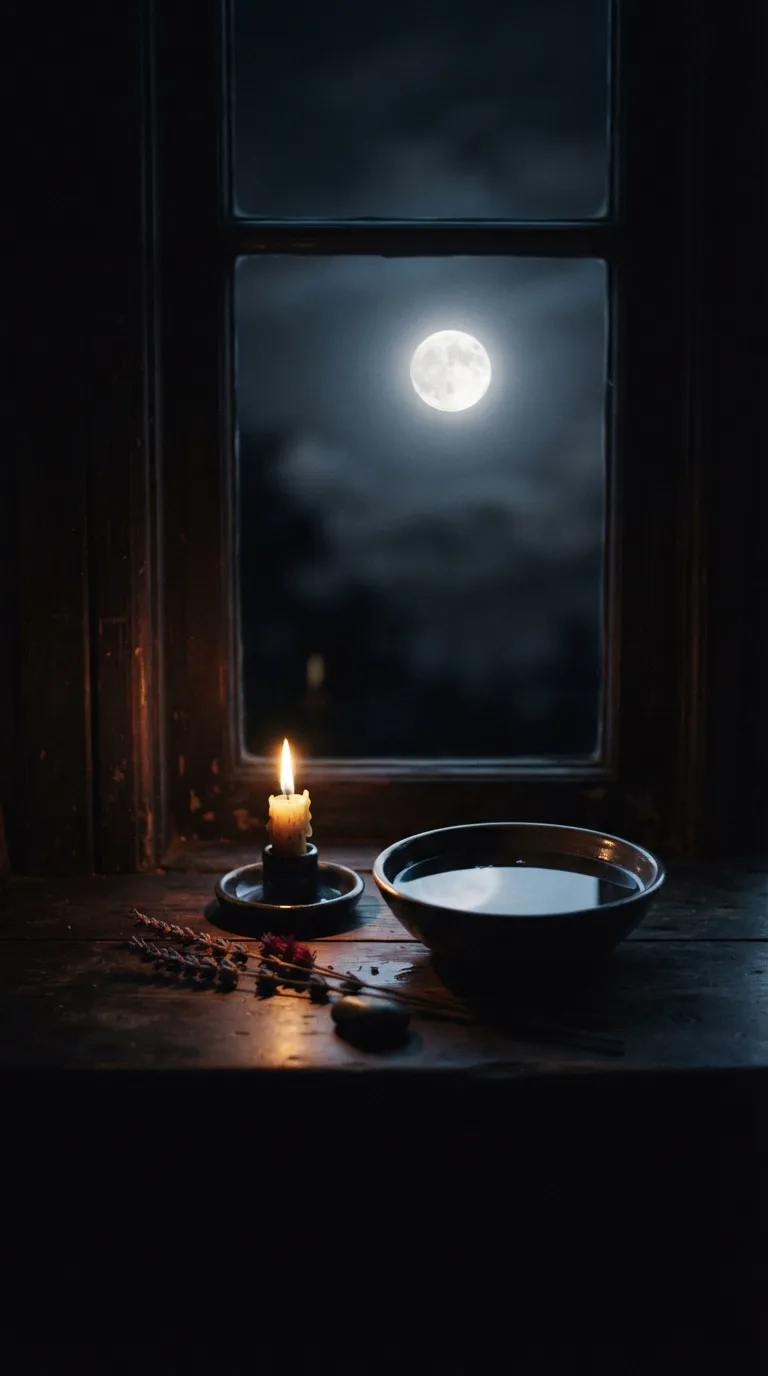
The moon has been used as a calendar for emotional work across many cultures. The waning moon, when the light shrinks, is traditionally the time for releasing. The new moon, a dark sky and a fresh start, is a time for setting an intention. The full moon, bright and complete, is a time for seeing clearly and giving thanks. Nothing about the moon changes the facts of a breakup. What it gives you is a rhythm: a monthly reason to pause, take stock and begin again.
We cover the tradition in more depth in our moon phases and love work guide and in the post on full moon love rituals. Those pieces are aimed at love work in general. This section is for grief.
A waning-moon release
In the week or two after the full moon, choose an evening. Light a candle. On a slip of paper, write three things you are ready to release: a habit, a resentment, a hope that has run its course. Read each aloud. Then let the paper go: safely burn it, tear it and put it in the trash with ceremony, or dissolve it in a bowl of water and pour the water onto the earth. Put the candle out. Spend a quiet few minutes before bed.
A new-moon intention
At the dark of the moon, write one gentle intention for yourself. Not “I want them back” and not “I want them to suffer.” Something that belongs to you: “I will sleep through the night.” “I will see my friends once a week.” “I will stop checking their profile.” Place the paper under a plant or in a drawer you open daily, and review it at the next new moon.
A full-moon thank-you
When the moon is full, step outside or look from a window. Thank the relationship for what was good in it, even if what was good was small. Thank yourself for getting through the month. Gratitude does not erase the hurt. It adds something next to it, and over time that something grows.
Keep it light
If you start timing everything to the moon and feeling anxious when you miss a night, you have made one more thing to fail at. The moon is an invitation, not a deadline. Skip a month without guilt.
Practice six: honoring the ancestors
In many West African traditions, including the ones Baba Ali’s lineage comes from, a person is never alone. The ancestors, the people who came before you, are understood to be present and interested in your wellbeing. Honoring them is an everyday practice, not a rare ceremony. After a breakup, when the person you leaned on is gone, turning to the line of people behind you can feel like finding a floor under your feet.
A simple home offering
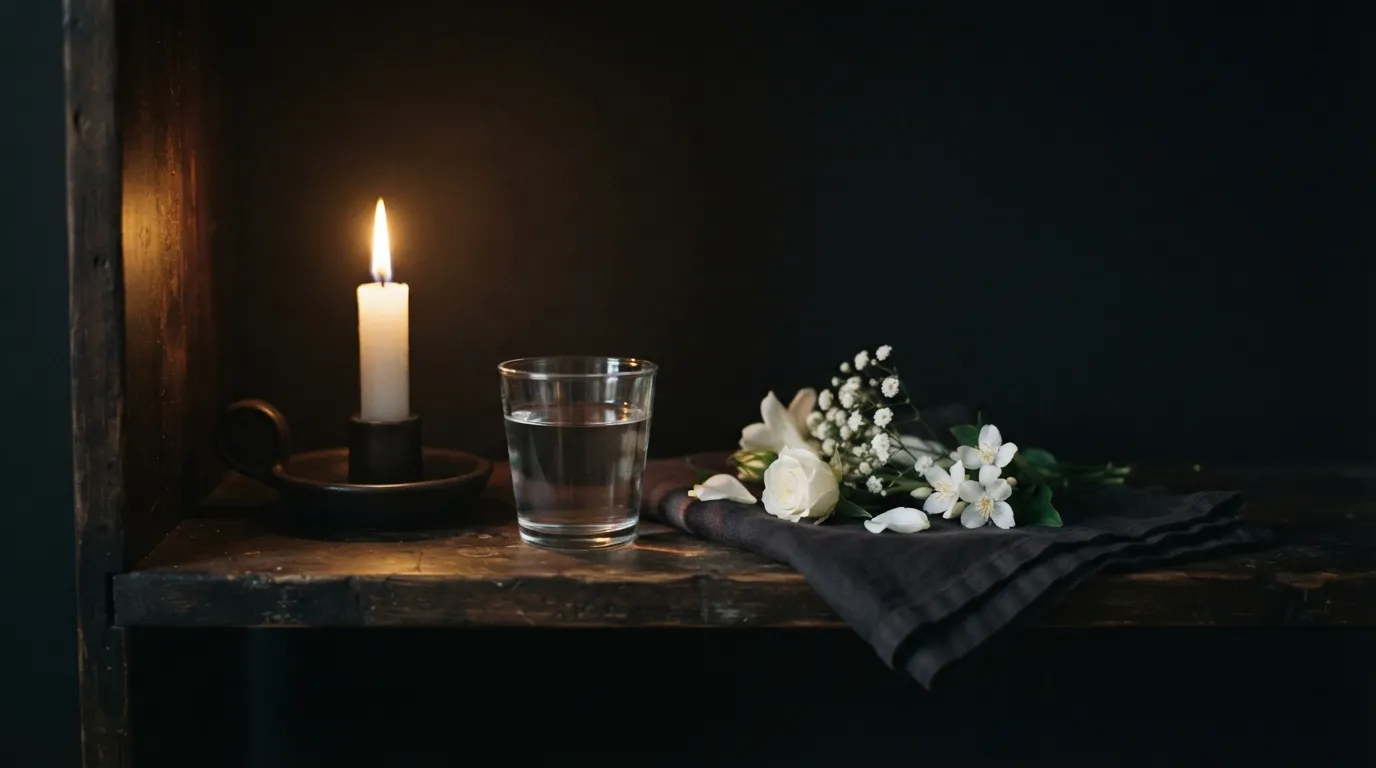
Find a quiet corner, a shelf or a small table. Place on it a glass of fresh water, a white candle and, if you like, a few flowers. If you have a photograph of a grandparent or elder you loved, put it there too. Light the candle, say the name of someone who came before you, and speak plainly: “I am having a hard time. I ask for your guidance and your strength.” Sit quietly for a few minutes. When you finish, put the candle out. Replace the water each day or two; many people pour the old water onto a plant or into the soil outside.
What to say
You do not need formal words. Tell them what happened. Tell them what you are afraid of. Ask what they would want you to remember about your own worth. Then listen. Some people hear nothing; some notice a memory, a sentence, a calm. Whatever arrives or does not arrive, the act of speaking to people who loved you, living or gone, is its own comfort.
If your family history is complicated
Not everyone has ancestors they want to call on. Some families were harmful. If that is you, you can honor the ancestors of the spirit, the teachers, grandmothers and elders who were kind to you, whether or not they shared your blood. You can also keep the altar simple and speak to the Creator or to the idea of your own better self. Nobody is required to honor anyone who hurt them.
Is this “voodoo”?
In the way most people mean the word, partly. West African spiritual tradition, from which Vodun and New Orleans Voodoo grew, places strong emphasis on ancestors, water, candlelight and community. It is not about dolls and pins, and none of what is described here involves harming or controlling anyone. If you are curious about the roots, our guide to what voodoo is explains the tradition honestly.
When your situation is more specific
The practices above are general. People come to a breakup from very different places, and a few situations deserve their own notes.
You were left, and it came out of nowhere
Blindsided grief is often the loudest. The mind keeps searching for the clue it missed. Lean toward grounding and prayer first, journaling second. Hold off on asking “why” for a few weeks; the answer is usually not available while you are this raw. If you find yourself desperate to know whether something spiritual caused the split, a love reading consultation can offer a calm outside view of what is going on, without any promises about outcomes.
You ended it and you feel guilty
People who leave grieve too, and they often hide it because they feel they have no right. You do. Do the ancestor offering and the full-moon thank-you. Write the unsent letter with space for regret and for relief. Both can be true.
Your ex has already moved on
This one stings in a special way. The urge to monitor their life is strong. Make a rule: no checking, not even once a day, for two weeks. Replace it with a grounding practice at the exact time you usually look. If the ache is about being replaced, the journaling question “what part of me got smaller” is a good place to start. We write about the quieter side of this situation in our post on reconciliation when an ex has moved on.
You are in no-contact
No-contact is easier to hold with a practice beside it. Pick a daily anchor, a morning breath or an evening candle, and use it when the urge to reach out spikes. Our post on no contact and love spells explains how many people use the quiet time.
You are long-distance, or the split was an ocean away
Distance blurs the edges of a breakup. There is no shared grocery store to avoid, only a phone full of reminders. Mute the notifications, not just the person, and give your attention a physical anchor: a candle, a plant, the ancestor corner. Ritual makes a distant loss feel real enough to grieve.
The relationship was unhealthy or controlling
If you left a relationship where you were frightened, controlled, followed or hurt, your first priority is safety, not reflection. The National Domestic Violence Hotline is free and confidential at 1-800-799-7233. Grounding practices can still help, but ritual is no substitute for safety planning and professional support.
A gentle two-week rhythm you can start tonight

If you want a starting point that does not require deciding between all six practices, try this for fourteen days. It takes about twenty minutes a day on a normal day.
- Every morning: drink a full glass of water, then five minutes of the 4-in, 6-out breath. Step outside if you can.
- Every evening: ten minutes of structured journaling using one question from the list above. Close the notebook when the timer ends.
- Three evenings a week: a short prayer or a ten-minute sitting before bed.
- Once during the two weeks: one cleansing bath or foot soak, with a clear thing to release.
- Once during the two weeks: one ancestor offering, even a very short one.
- If the moon is in the right phase: one release or intention ritual from the moon section.
At the end of the two weeks, ask yourself three plain questions. What helped? What felt forced? What do I want to keep? Drop the practices that did not fit and keep the ones that did. There is no correct set, only the one that works for you.
A word about days you miss. You will miss days. Someone will text, a song will play, you will fall apart in a grocery store. Pick the practice back up the next morning with no speech about failing. The point of a rhythm is not perfection. It is having somewhere to return to.
What to avoid while you are healing
Some habits look spiritual and quietly keep you stuck. A short list, offered gently.
Avoid performing rituals aimed at your ex. A candle lit with the thought “bring them back” is a different act from a candle lit with the thought “help me through tonight.” The first keeps your attention on them. The second brings it home to you. If you do reach the point where you want to explore reconciliation work, that deserves its own clear-headed decision, not an unplanned side effect of a grief practice. Our post on love spells and free will explains how ethical practitioners think about that line, and why no real practitioner treats it as a way to remove anyone’s choice.
Avoid making big decisions in the first weeks: moving across the country, quitting a job, getting a tattoo of a new ideal. Grief makes everything feel urgent. Most of it is not.
Avoid using ritual to numb. If you notice that you reach for the bath, the candle or the prayer to avoid feeling anything, that is a sign to slow down, not speed up.
Avoid the rebound-as-medicine pattern. A new person can be lovely company, but a new relationship started to fill a hole usually repeats the old pattern. Give yourself time to know what you want.
Avoid advice that tells you your breakup was your fault because of your “energy” or what you “attracted.” Relationships end for a lot of reasons, and most of them are not a spiritual failing on your part. If a guide, a reader or a friend leaves you feeling blamed, you can put it down.
And avoid going it alone. People heal faster with company. Tell two friends what you are doing. Sit with family. Say the plain, unspiritual thing to someone who loves you: “I am not okay.”
When spiritual practice is not enough: seeking counseling
This section matters more than anything above it. Ritual can hold grief. It cannot treat depression, anxiety, trauma or a crisis. Plenty of people use both, and Baba Ali encourages it.
Consider speaking with a licensed counselor, therapist or your doctor if:
- Your sadness, anxiety or numbness is not easing after several weeks, or it is getting worse.
- You cannot sleep, or you sleep nearly all day, most days.
- You have lost or gained a lot of weight, or cannot eat.
- You are drinking or using substances to get through the day.
- You cannot work, study or care for people who depend on you.
- You have intrusive thoughts about the relationship that you cannot interrupt.
- The breakup involved abuse, stalking, or a frightening ending.
- You feel hopeless, or you have thoughts that life is not worth living.
If you are having thoughts of harming yourself, please do not wait. In the United States, call or text 988 to reach the 988 Suicide & Crisis Lifeline. It is free, confidential and open at any hour. If you are in immediate danger, call 911.
If you are in or leaving a controlling or violent relationship, the National Domestic Violence Hotline at 1-800-799-7233 can help you plan safely.
Starting therapy is not a failure of faith. Many counselors are comfortable working with clients’ spiritual and cultural practices, and some specialize in it. If you want a counselor who respects your tradition, say so on the first call and ask directly. A good one will welcome the question.
Where love work fits, if you want it to
Some people read a guide like this and realize that grief is only part of what they want. They also want to know whether the relationship can be repaired. That is a legitimate question, and it is separate from the practices above.
Here is how Baba Ali frames it. First, work on yourself. Steady your sleep and your breathing. Let the first wave pass. Second, get clear on what you want and why. If you want the person back because you miss them, that is understandable. If you want them back because you cannot stand being alone, the grief practices come first. Third, if reconciliation still feels right and the other person has a real chance of wanting it too, you can talk with a practitioner about what is possible, honestly and without promises.
Some people find that the relationship itself needs spiritual repair rather than a dramatic fix, and the heal a broken relationship work is aimed at those situations. Others want to understand where a particular tie stands and whether a reunion could be healthy, and the reconciliation spell service is described there in plain terms. Neither is a replacement for the practices in this guide, and neither removes anyone’s choice. No practitioner can promise a fixed result, and anyone who does should be treated with caution.
If you are not sure which, if either, you want, start with the grief practices. Clarity tends to come on its own once the noise in the body quiets down.
Related reading: Ex Back Spells After a Breakup: What to Consider First and When Should You Reach Out to an Ex After a Breakup?.
Frequently asked questions
What are the best spiritual practices after a breakup?
There is no single best one. The most useful starting points are grounding (slow breathing, bare feet on the earth, drinking water), a weekly cleansing bath, structured journaling, a short evening prayer or sitting, and a simple ancestor offering. Pick one or two and do them daily for two weeks before adding anything else.
How long does it take to heal after a breakup?
It varies widely. It depends on how long the relationship was, whether you chose the end, how much support you have, and what else is happening in your life. Some people feel steadier in a few weeks; others need many months. If you are not improving at all after several weeks, or you are getting worse, speak with a counselor or doctor.
Can a cleansing bath really help with heartbreak?
A bath will not erase grief, but many people find that the ritual gives the day a clear end and the body a chance to relax. It is a way of marking a boundary between the hard part of the day and the rest of it. See our cleansing baths guide for recipes and safety notes.
Is it okay to do these practices if I still want my ex back?
Yes, as long as the practice is about your own healing and not an attempt to reach or influence them. Grief practices help you think clearly about what you want. If you later decide to explore reconciliation, you can do that as a separate, deliberate step.
I am not religious. Can I still use spiritual practices?
Yes. Breathing, journaling, time outdoors, and quiet reflection do not require any belief. If candles and offerings feel awkward, skip them. Use whatever feels honest to you and leave the rest.
Does journaling always help after a breakup?
Not always. Research on expressive writing after relationship separation has found mixed results, and for some people repeatedly retelling the story can slow recovery. Use short timed sessions, ask questions that look forward or toward yourself, and stop if the writing leaves you more agitated than before.
When should I see a counselor instead of, or alongside, spiritual practice?
See a counselor or doctor if your symptoms last for several weeks or worsen, if sleep, eating or work are badly disrupted, if you are using substances to cope, or if the breakup involved abuse. If you ever have thoughts of harming yourself, call or text 988 right away. Using counseling and spiritual practice together is common and sensible.
Should I use rituals to get my ex to contact me?
Not as a grief practice. Mixing the two keeps your attention on the other person and slows your own recovery. If you want to explore reconciliation, that is a separate decision, and an honest practitioner will talk it through without pressure and without promising a particular result.
A last word from Baba Ali’s practice
A breakup ends a story you thought you were still living in. The practices in this guide will not tell you how the next chapter goes. They will help you get through tonight, then tomorrow, then next week, with your dignity and your sleep a little more intact each time. Start with the smallest one that appeals to you. Light the candle, take the bath, write the ten minutes, say the name of someone who loved you. If you would like a calm, outside perspective on where you stand, you can always book a love reading consultation. And if the weight is more than ritual can carry, please reach for a counselor or the 988 line. Asking for that help is also part of a spiritual life.