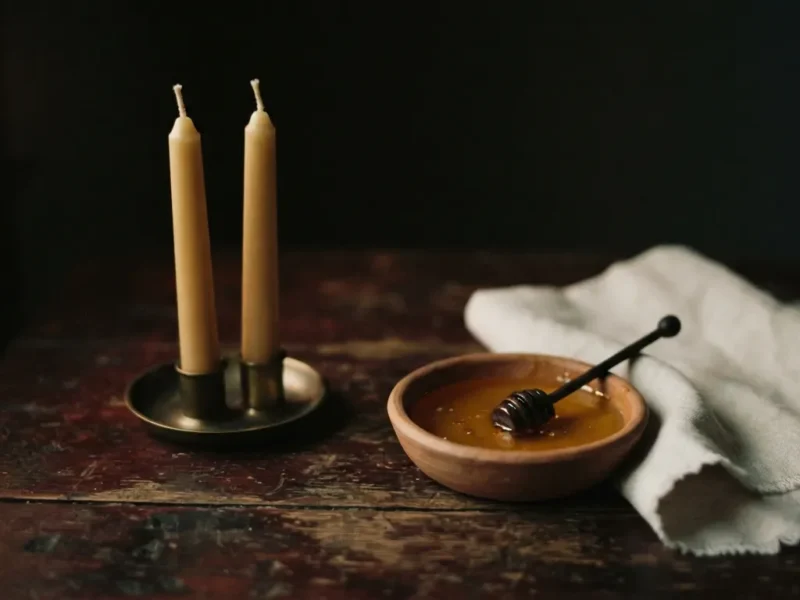
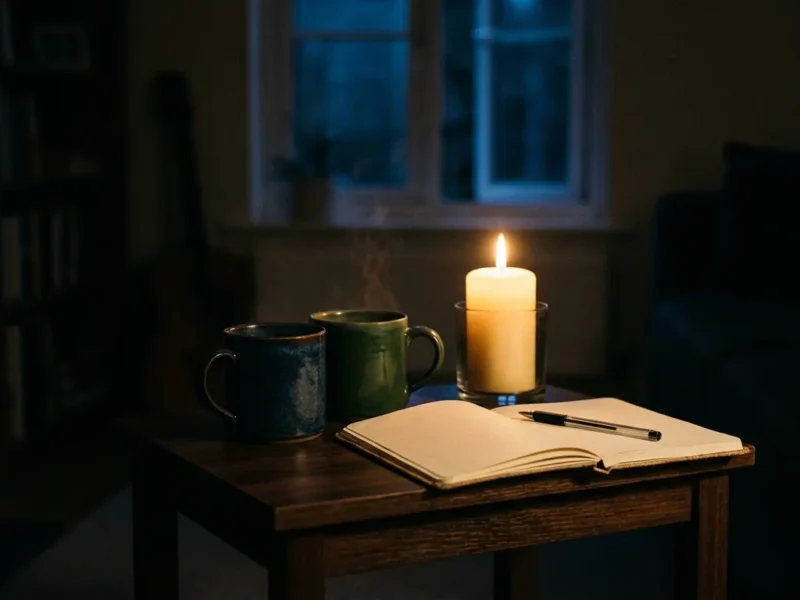
A candle ritual for reconciliation and communication is a short, structured practice in which you light one or more candles with a clear, honest request: that a broken bond be given a chance to mend, and that two people who have stopped talking find words again.
It is not a way to take control of another person. It is a way to settle your own mind, state what you want in plain language, and put your attention on repair before you say or send anything.
Most pages on this topic hand you a candle color and a sentence to repeat, then leave you alone. This guide goes further. It covers how to set the intention, which candle suits which job, when to light it, how to burn it safely, what to do the day after, and what to do when the situation is messier than the tutorials assume: an ex who has moved on, months of silence, a partner in the next room who will not speak. If you want a full list of what every color means, see our candle colors guide. This post is about the practice itself.
What this ritual is, and how it differs from a color guide

There are two jobs a candle can do in this kind of work, and they are not the same job. Reconciliation work concerns the bond: the hurt, the distance, the unfinished business between two people who once cared for each other. Communication work concerns the line between you: whether messages get answered, whether a conversation can start without turning into a fight, whether silence can break.
Sometimes you need both. Sometimes the bond is fine and the line is down, as in a couple who love each other and cannot get through a dinner without a quarrel. Sometimes the line is open and the bond is damaged, as when two people talk daily but one of them cannot forgive what happened. Knowing which job you are asking the candle to do is the first real decision, and most online tutorials skip it.
That is also where this post parts ways with the color guide. The color guide answers the question “what does pink mean?” This one answers “what do I actually do on Tuesday night with a pink candle, a pen and a box of matches?” If you want a broader view of candle work in our tradition, including preparation, wax types and what to do with the remains, the candle magic guide covers it. For the wider topic of spoken and written words between partners, there is a companion piece on communication spells for love.
In Baba Ali’s practice, which comes from a Senegalese ancestral lineage and more than thirty years of work, the candle is never the whole of the work. It is the part you can see. The rest is what the person lighting it decides to do afterward: whether to send the message, whether to apologize, whether to wait. We come back to that in the aftercare section, because it is where most rituals quietly succeed or fail.
Start with the intention, not the candle
People usually reach for the candle first. Slow down. A candle burned without a clear intention is just a candle. A candle burned with a muddled one tends to add confusion to a situation that already has plenty.
Sit down with a pen and paper before you buy or light anything and answer three questions in your own words.
First: what am I asking for? Not “for him to come back.” That is an outcome you cannot control and a framing that treats another person as an object to be moved. Try instead: “for an honest conversation between us,” or “for the anger between us to soften enough that we can speak,” or “for a chance at repair if repair is right for both of us.” The wording matters because it shapes what you do next. A request for a conversation sends you toward a conversation. A request for a specific person to return sends you toward waiting by the phone.
Second: what is my part? Reconciliation is almost never one-sided in cause, but your part is the only part you can change. Maybe you said something cruel. Maybe you disappeared. Maybe you held on to a grievance long after it needed to be spoken. Write it down plainly. A ritual that names your own part carries a different weight than one that only asks for the other person to change.
Third: what am I willing to do after the candle burns out? If the honest answer is “nothing, I just want the candle to do it,” the ritual is not ready. Candle work supports action. It does not replace it. Decide now what the action is: a call, a letter, an apology, a request to meet in a public place, a decision to wait two weeks before reaching out.
Once you have those three answers, condense them into one or two sentences. This is your petition. Here are a few examples in the tone we recommend, plain and without demands:
- “I ask that the silence between us be broken in a way that is safe and honest for both of us.”
- “I ask for the courage to apologize for my part, and for a listening heart on the other side.”
- “If our bond is meant to be repaired, I ask that the way open. If it is not, I ask for peace.”
Notice the last one. Many people resist the final clause, because it admits that the answer might be no. We keep it in, for two reasons. It is more honest, and it protects you. A ritual that leaves room for the answer to be no is one you can survive, whichever way things go.
Choosing the candle for reconciliation
For reconciliation work, the traditional choices lean soft. Pink is the usual first candle for healing a bond after hurt: tenderness, forgiveness, the gentle return of affection. White is for clearing and peace, and it suits the early stage when the main task is to calm the water. Red belongs in the picture only when anger has already cooled and what is left is longing, since red candles can feed a fight if lit while the fight is still going.
A practical way to choose: ask what the main feeling in the room is.
- If it is hurt and distance, begin with pink.
- If it is anger, tension, or chaos, begin with white to clear, then move to pink in a later session.
- If it is guilt on your side, white is a good first candle, with pink to follow.
- If it is longing and the anger is truly gone, a red and pink pair can work together.
Do not worry if you cannot find the ideal color. A plain white candle can stand in for any of them, a point we cover in more depth in the colors guide.
Choosing the candle for communication
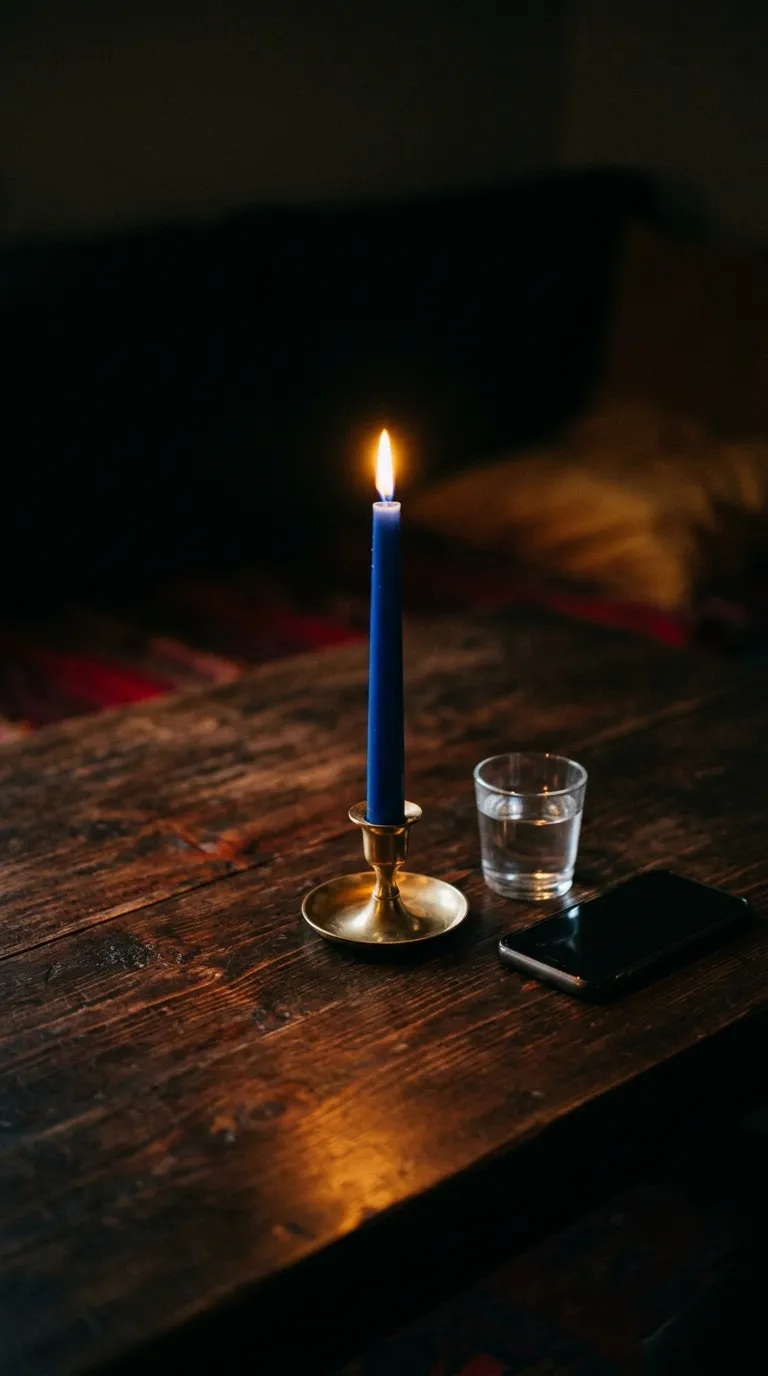
Communication work asks for a different palette. Blue is the traditional color for clear, calm speech and honest dealing. It is steady, cool, and good for situations where conversations tend to heat up. Light blue is gentler; royal blue is firmer. Yellow is sometimes used when the main problem is stuck thinking, and a muddy, circular argument that goes nowhere. Orange is used for opening doors, which in this context means getting a first message answered or a first meeting agreed.
For most people, one blue candle, lit alongside a white or pink candle for the bond, is plenty. That pairing says: “I want to be heard, and I want the heart behind the words to be kind.”
One candle or two?
We often recommend a two-candle arrangement, and the logic is worth explaining. The first candle represents you: your intention, your part, your willingness to speak honestly. The second represents the bond or the line between you. Placing them a few inches apart, never touching, gives the ritual a clear shape. You are not lighting a candle “for” another person. You are tending your side and asking for the bond to be given room.
A figure candle, one shaped like a person, is sometimes used in other traditions for this kind of work. In reconciliation and communication, we usually advise against it. Figure candles tend to encourage the idea that you are working on someone, and that framing leads to the wrong expectations. Plain tapers, pillar candles, or seven-day glass candles do the job better and more respectfully.
Taper, pillar or glass?
A taper burns quickly, usually an hour or two, and suits a single sitting. A pillar burns longer and can be used over several nights. A glass-encased candle is the safest to leave burning while you are at home, which makes it popular for multi-day work, though no flame should ever be left unattended. If you are new to this, start with two tapers or small votives. You will see the whole burn, and you will not feel pressure to keep a flame alive for days.
Dressing the candle
Dressing means preparing a candle with oil or other small items before lighting it. Keep it simple. A drop of olive oil or a neutral carrier oil, rubbed from the base to the wick for pulling something toward you, or from the wick to the base for sending something away, is enough. Reconciliation work generally uses the pull direction. A pinch of dried lavender for peaceful speech, a few rose petals for an open heart, or a thin line of honey on the saucer beneath the candle for sweetening are all traditional. Do not add anything you are allergic to, and never put herbs or oil on a candle that is already lit. More on that in the safety section.
Carving is optional. If you want to, scratch a short word into the wax with a pin: “peace,” “speak,” or “open.” Avoid writing the other person’s name as an instruction. A name written on a candle as a demand turns the ritual into the sort of pressure we do not do.
Timing: when to light the candles
Timing is the part people argue about most and the part that matters least. Here is what tradition suggests, and what actually helps.
Traditionally, work for reconciliation and for opening a closed line is started while the moon is waxing, which is the stretch from new moon to full moon, when things are understood to grow and gather. The full moon itself is used for bringing something to a head, and the waning moon for release. If you want a deeper look, our guide to moon phases and love work sets out the reasoning, and you can confirm the current phase at NASA’s moon phase page.
Friday is the day traditionally associated with love and affection, and evening, after the day’s noise has died down, is the usual hour. Many practitioners avoid starting this kind of work in the heat of an argument, and so should you. If you and your partner fought this morning, a candle at midnight is not the answer. Wait until the worst of the feeling has passed.
The timing that matters most is practical. Choose a night when you will not be rushed, when your phone can be silenced, and when you will not be interrupted. A ritual done in a hurry between chores is a weaker ritual than a simple one done calmly. If the moon is wrong and you are ready tonight, light the candle tonight. A calm person with a clear intention on the “wrong” night outperforms a distracted one on the “right” night.
Setting up your space and burning safely
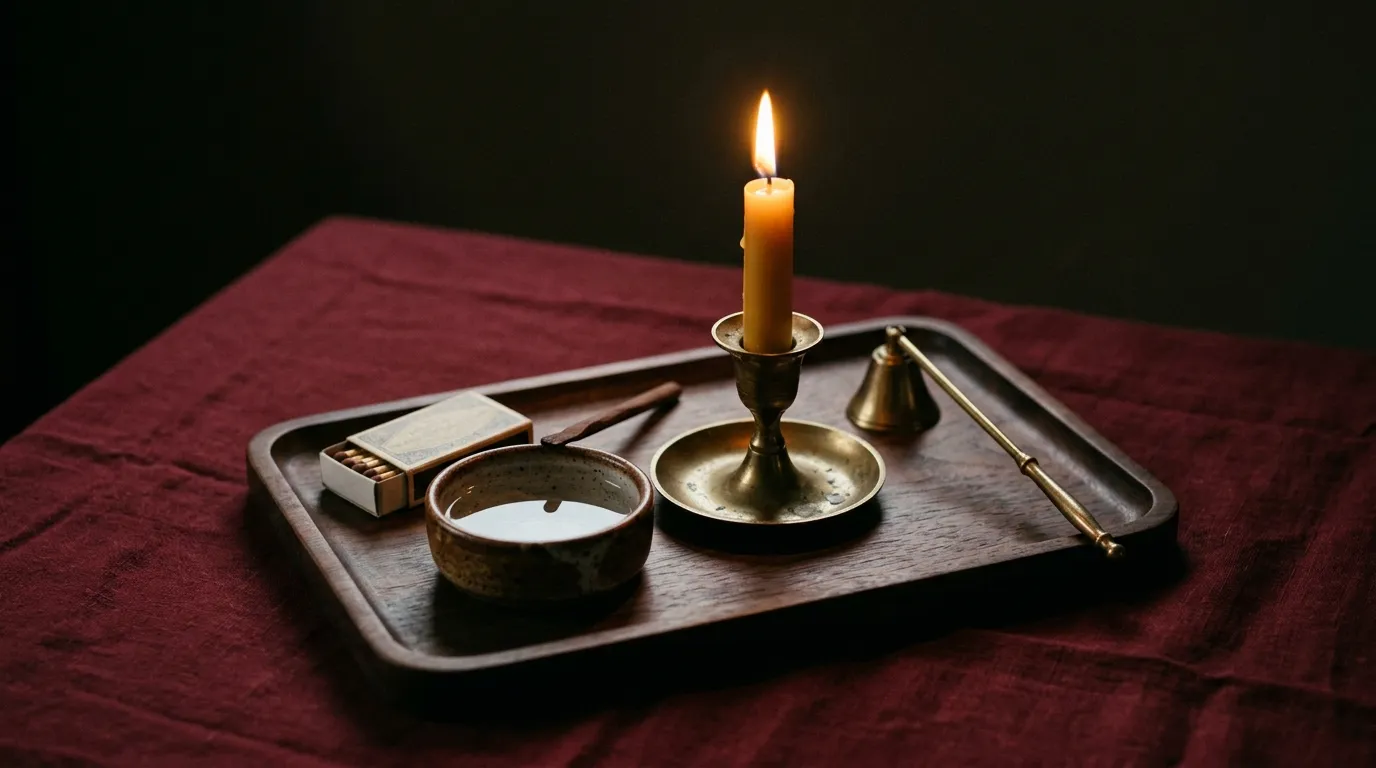
A candle is an open flame, and your plans for it should start with safety, not atmosphere. The National Fire Protection Association publishes home candle safety guidance that is worth reading once. In short: keep flames well away from anything that can catch fire, use a sturdy holder, never leave a burning candle in a room you have left, and put it out before you sleep.
Here is the setup we recommend.
- A heat-safe, stable surface: a ceramic plate, a metal tray, or a tile. Not a stack of books, not a windowsill with curtains.
- Clear space around the candles: nothing flammable within about a foot. That includes paper, fabric, dried herbs you are not using and hair.
- A bowl of water or a metal snuffer within reach.
- Matches or a long lighter, kept off the table once the candle is lit.
- A fire-safe dish if you plan to burn your written petition. Paper burns fast and flares, so hold it with tongs or over the sink, not in your hand.
- Pets and children kept out of the room.
Snuff the candle rather than blowing it out. Snuffing is safer, since blowing can scatter hot wax, and many practitioners prefer it because it feels like closing a prayer rather than discarding it. If a candle spits, smokes or burns unevenly, it is usually down to a draft, a wick that is too long, or herbs that got into the flame. Fix the draft or trim the wick. We read little into it, and we cover that honestly further down.
If you need to stop a ritual part way, you can. Put the flame out and resume the next night. Nothing is lost. The work is not made of the flame; the flame holds your attention.
A three-night reconciliation ritual, step by step

This is a simple structure we give to people who want to do the work themselves. It uses three short sittings, one per night, each with a different purpose: clear, open, invite. Each takes about twenty to thirty minutes. You will need a white candle, a pink candle, paper, a pen, and your safe setup. Add a blue candle if communication is also part of the work.
Night one: clear
Wash your hands and, if you like, take a cleansing bath earlier in the day; our guide to cleansing baths gives the basics. Sit down with the white candle. Before you light it, write out everything you are angry about, ashamed of or afraid of regarding this relationship. Do not edit. This page is for you alone.
Light the white candle. Read your page once, quietly. Then say, in your own words, that you are setting these feelings down. When you are done, fold the page and put it aside. Do not burn it yet; some people keep it until night three, and some prefer to tear it up. Sit with the flame for a few minutes in silence, then snuff it.
Night two: open
Take your pink candle and, if you plan to, dress it lightly. Write your petition, the one or two sentences you built earlier. Light the pink candle and read the petition aloud. If your voice shakes, let it. Then think of one specific thing you appreciated about this person or this relationship. Not a vague feeling; a concrete memory. A shared meal. A joke only the two of you got. Hold it for a minute.
That small step matters more than it seems. Relationship researchers at the Gottman Institute describe a pattern in which stable couples keep a ratio of roughly five positive interactions to every negative one during conflict (their explanation of the ratio is here). Rehearsing a real, specific good memory is a way to put your own side of that ratio back in order before you open your mouth. Snuff the candle when you are ready.
Night three: invite
Light both candles, white and pink, with space between them. If communication is part of your request, add the blue one. Read your petition again. Then, in a few plain sentences, describe the first step you will take: “Tomorrow I will send a short message,” or “On Saturday I will ask if we can meet.” Say it aloud. This is the invitation: you are telling the work, and yourself, that you will meet it halfway.
Let the candles burn down if they are small and you can stay in the room, or snuff them after about thirty minutes and relight for another sitting if needed. Burn or tear the night-one page in a safe way, or bury it. Wash your hands. Close the ritual with a simple word of thanks. Then, and this is the point, go to bed and do the ordinary things the next day. The candle is done; your part begins.
A communication candle before a hard conversation
Sometimes you are not asking for reconciliation at all. You already have a conversation scheduled, and you are afraid it will go badly. This short version takes ten minutes and can be done the evening before or an hour before you talk.
Light a single blue candle. Sit comfortably. Write at the top of a page the one thing you most need the other person to understand. Under it, write the one thing you most need to understand about them. Then write one sentence you will not say, such as an old insult, a threat, or a score you want to settle. Read all three lines. Then say: “May I speak clearly, and may I listen well.” Snuff the candle.
Keep that page in your pocket, or at least in your head. When the conversation gets heated, it is the reminder that you came to speak and listen, not to win. For the words themselves, we have a separate piece on what to say when asking an ex to try again.
What to do with the words once the candle is out
The ritual brings your mind to a better place. The conversation still has to happen in the real world, and a few habits make it far more likely to go well.
- Start soft. Open with something specific and warm rather than a complaint. The Gottman Institute’s writing on the four horsemen of conflict (criticism, contempt, defensiveness and stonewalling) is a good checklist of what to avoid.
- Own your part first. One honest sentence about what you did, said or failed to do will soften the room more than any candle.
- Keep it short on the first contact. A first message does not need to settle everything. It needs to open a door.
- Ask, do not demand. “Would you be open to talking this week?” leaves the other person free to answer, and it makes a yes more meaningful when it comes.
- Accept the pace. If the answer is “not yet,” that is information, not a failure of the ritual.
If you are not sure how to approach a first message after a long silence, our guide on how to reopen communication after no contact walks through timing and wording.
Notes for different situations

The standard steps above assume two people who are both reachable. Real life is rarely that tidy. Here is how we adjust the work for the cases people ask about most.
You and your partner live together but have stopped talking
Do the ritual alone, at a time when your partner is out or asleep, in a place where the flame can burn safely. You are not working on your partner; you are preparing yourself. Keep the petition focused on the line between you, with blue and white as the colors. Then pick one small, concrete gesture, such as making them tea, leaving a short note, or asking whether Sunday morning would suit a talk.
You have been in no contact
No-contact periods have their own logic, and a candle ritual should respect them. If you agreed to a no-contact period, or the other person asked for one, the ritual is about your own readiness, not about breaking the silence early. Use white for clearing and pink for healing, and work on your side of things. When the period ends, then the communication candle has a use. Our piece on no contact and love spells explains how the two fit together.
Your ex has moved on
This is the hardest case, and the honest answer is that a candle will not change another person’s feelings or relationships. What it can do is help you settle the grief and decide whether to reach out at all. Keep the petition open-ended: “If there is room for repair, let it show itself. If there is not, let me find peace.” We cover this situation at length in reconciliation when an ex has moved on, including the point at which it is time to stop.
Long distance
Distance does not change the ritual; it changes the follow-up. Pair the communication candle with a practical plan: a set day for a video call, a letter that arrives by mail, a shared calendar. See long-distance love work if the physical gap is part of the problem.
After a specific argument
If the break came from one fight, a single night of white and pink is often enough. You are not trying to solve the relationship; you are trying to get back to a point where a calm conversation is possible. The guide to reconciliation after an argument goes deeper.
When someone else is involved
If a third person, a family member, a former partner or an outside pressure is making repair harder, the candle for the bond may not be the right place to start. That is a different kind of work, and clearing third-party interference addresses it directly.
Aftercare: the week after the candle
Aftercare is the part almost no tutorial mentions, and it is where much of the real result comes from. When the candles are done, you are in a short period of heightened attention. How you spend it matters.
Take your first practical step within a day or two, as you promised on night three. Not on the same night, and not weeks later. Send the message. Make the call. Write the letter. A ritual followed by weeks of inaction loses its meaning.
Look after your body. Sleep, eat, drink water, step outside. People often do this work when they are at their lowest, and an exhausted person reads every silence as rejection. A short walk is aftercare.
Avoid obsessive checking. It is tempting to refresh a phone every ten minutes. Set times to look at your messages, perhaps morning and evening, and leave the phone alone between them. Constant checking turns hope into anxiety, and anxiety shows in how you write and speak.
Keep a short log. Each evening, write one line: what you did, what you noticed, how you felt. After a week, you will see patterns that memory alone would miss, and you will have a more reliable view than the one your anxious mind offers at 2 a.m.
Dispose of candle remains with respect. Let the wax cool, then wrap it and place it in the household rubbish, or bury it in the garden. Do not flush ashes down the toilet or leave remains where a pet can get to them. For more on this, see the section on remains in the candle magic guide. If you wish to continue, our page on what to do after a love spell is cast covers the weeks that follow.
Reading the flame and the wax honestly
Many traditions read candle behavior: a tall steady flame as a good sign, a flickering or smoking one as resistance, a glass that blackens as something being drawn out. We think there is some value in paying attention, but also a strong case for restraint.
A flame moves for ordinary reasons: a draft, an uneven wick, moisture in the wax, a herb that dropped into the flame. A glass candle blackens when the wick is too long. If you see a strong flame and feel hopeful, enjoy it. If you see a flickering one, trim the wick, close the window and keep going. Do not build a story about a person’s feelings from a candle’s behavior. The measure of the work is what happens in your life over the following days and weeks: whether a reply comes, whether a conversation opens, whether your own heart settles.
That is also why we do not list “signs” such as dreams or sudden thoughts of the person as proof. They are easy to find when you are looking for them and just as easy to explain away. Real signs are things you can point to: a message answered, an invitation accepted, a tone softened.
When not to light the candle
There are situations in which reconciliation is not what a person needs, and a candle ritual would be the wrong tool.
If the relationship involved violence, threats, stalking, or a partner who will not accept a clear “no,” do not use this ritual to draw them closer. Your safety comes first. The National Domestic Violence Hotline is available at any hour on 1-800-799-7233 or at thehotline.org.
If the other person has told you clearly that they do not want contact, respect it. A candle cannot lawfully or ethically override a request for no contact, and any work that tried to would be work we would not do. What you can do is a ritual for your own peace and healing.
If you are lighting a candle mostly because you cannot bear to stop checking, texting or hoping, consider whether support from a friend, a counselor or a therapist would serve you better, alongside or instead. There is no shame in that. Spiritual work and professional support can sit side by side.
Finally, if you notice that the ritual has become a daily compulsion, with the candle lit every night for weeks and no real-world step taken, it is time to stop and take that step. Doing more of the same is not the answer.
Doing it yourself, or asking Baba Ali to do it

Everything in this guide can be done at home with materials that cost very little. Many people do exactly that and are glad they did. Others want an experienced practitioner to prepare, dress and burn the candles on their behalf, particularly when the situation is tangled, long-standing, or complicated by distance or interference.
If that is you, Baba Ali offers a love candle ritual, in which the candles are prepared and burned for your specific situation. For work focused on a rift between two people, see the reconciliation spell service. If you are not sure what you need, a love reading consultation is the right place to start, because it begins with your situation rather than a package. And for a gentler approach to a bond that is damaged but not gone, there is heal a broken relationship.
Baba Ali never pressures anyone, and no practitioner can promise a fixed result in a person’s heart. What the work offers is a focused, respectful effort to open a path. Money-back guarantee: no change within 7 days, full refund. See the refund policy for details. Our approach to ethics, including what we will and will not do, is set out in the love spell ethics guide.
For a wider introduction to the full set of reconciliation approaches, including cases that need more than candles, read our reconciliation spells guide.
Related reading: Communication Spells for an Ex: Reopening the Door to Conversation and Reconciliation Rituals for Reflection, Healing and Renewal.
Questions about candle rituals for reconciliation and communication
What is the best candle color for reconciliation?
Pink is the usual first choice for healing a bond after hurt, with white for clearing the air first if anger is still high. For communication, add a blue candle. If you only have one color available, use white. For a full color-by-color breakdown, see our candle colors guide.
Can I do a candle ritual without the other person knowing?
Yes, and most people do. The ritual is about your own intention and readiness, so the other person does not need to be involved. What it does not do is remove their choice. Whether to reply, meet or reconcile stays with them, which is why the work ends with a real conversation and not with the candle.
How long should I burn the candles?
For the three-night structure, twenty to thirty minutes per night is enough. Small tapers or votives can burn all the way down while you sit with them. Do not leave any flame unattended or burning while you sleep, and snuff it out if you need to leave the room.
What if the candle flickers, smokes or goes out?
Usually it is a draft, a long wick or herbs in the flame. Trim the wick, close the window, relight and carry on. We do not treat a flickering flame as a verdict on the relationship. The meaningful results are the ones that show up in your life afterward, not the shape of the flame.
Should I send a message right after the ritual?
Wait until you feel calm, then act within a day or two. A short, warm, low-pressure message works better than a long explanation. If you are in a no-contact period that the other person requested, do not break it; use the ritual for your own healing instead.
Is it safe to burn the written petition?
It can be, with care. Hold the paper with tongs over a fire-safe dish or the sink, keep your hair and sleeves back, and never burn paper near curtains or other flammables. If you are not comfortable with it, tear the page up or bury it instead. The ritual works the same way.
What if my ex has moved on or the answer is no?
Then the most useful candle ritual is one for your own peace. Keep the petition open-ended, and be willing to accept that repair may not be right for both people. Our guide on reconciliation when an ex has moved on explains how to tell when to keep going and when to let go.
Can a candle ritual replace therapy or couples counseling?
No. Candle work can help you steady yourself and set an intention, but it does not teach conflict skills or treat deeper problems. Many people use both. If the relationship involves harm or fear, contact the National Domestic Violence Hotline at 1-800-799-7233 and put your safety first.