A communication spell is love work aimed at one specific problem: two people who love each other but have stopped talking, or who talk and only end up hurt. It softens defensiveness, eases the fear that keeps words stuck in a throat, and opens a window where a real conversation can happen.
It does not script what your partner says, and it does not remove their right to stay quiet if they truly want to. Most clients notice the first shift, a reply, a softer tone, an unprompted call, within 3 to 7 days. If you searched for a “communication spell,” this guide gives you a plain, honest answer: what the work actually does, how Baba Ali Musa performs it, a candle ritual you can do yourself tonight, and the exact words to use when the conversation finally opens.
This guide is written for couples, not only for exes. If your relationship is active, drifting, tense after a fight, or stretched thin by distance, this is the broader guide for you. If you are specifically trying to break a no-contact silence after a breakup, our post on no contact and love spells covers that narrower situation in detail, including when to break the silence and what to text first. This guide focuses on something wider: the everyday skill and spiritual work of keeping two people able to talk to each other, whether you are together, separated, or somewhere in between.
What a communication spell is, and what it covers
In Baba Ali’s practice, a communication spell is rarely one fixed ritual. It is a category of work shaped around a single goal: clearing whatever sits between two people and their next honest conversation. That barrier might be pride, hurt feelings, fear of saying the wrong thing, a pattern of shutting down the moment voices rise, or simple distance and bad timing. The spell work loosens that barrier. Candles, herbs and petition papers carry the intention; the conversation itself still has to happen between two people.
Communication spells get requested for situations far beyond breakups: a partner who goes quiet during every disagreement, a couple who used to talk for hours and now sit in silence, a long-distance relationship worn thin by missed calls, a fight that neither person knows how to bring up again without reopening the wound. The common thread is not an ex. It is two people who want to talk honestly and cannot find the door.
Why couples stop talking to each other
Most couples do not lose the ability to talk overnight. It erodes, one skipped conversation at a time, until silence becomes the easier habit. A few patterns show up again and again in readings:
- Criticism that lands as attack. A complaint about one behavior turns into a statement about someone’s whole character, and the other person stops listening to protect themselves.
- Defensiveness as a reflex. Every concern gets met with an excuse or a counter-complaint, so nothing is ever actually heard.
- Contempt, even in small doses. Eye-rolling, sarcasm and a tone that says “you’re beneath this conversation” teach a partner that speaking up is not worth the cost.
- Shutting down entirely. One or both partners go quiet mid-argument rather than work through it, which feels like safety in the moment and like abandonment to the other person.
- Exhaustion and resentment. After enough unresolved fights, some couples simply stop trying, not because they stopped caring, but because talking has started to feel pointless.
- Mismatched styles. One partner wants to talk things through immediately; the other needs a few hours to calm down first. Without naming that difference, each person reads the other’s natural pace as rejection or as pressure.
None of these patterns appear overnight, and none of them mean the love is gone. They are habits, learned under stress, and like most habits they can be named, worked with, and changed. That is the starting point for communication work: not blame, but a clear picture of what is actually happening between the two of you.
Relationship researchers at the Gottman Institute have studied these exact patterns for decades and named four of them, criticism, contempt, defensiveness and stonewalling, as the strongest predictors of a relationship’s decline (Gottman Institute). None of that means your relationship is doomed. It means the habit that is hurting you has a name, and habits can be changed.

Who this guide is for
Communication work fits a wide range of situations, and it helps to know which one is yours before you start, because the ritual and the conversation that follows look different depending on your case.
- A couple still together, drifting apart. You live together or see each other often, but real conversation has shrunk to logistics. This is the most common reason people come to Baba Ali for communication work specifically.
- A couple recovering from a specific fight. Something was said that neither of you has brought up since, and the silence around it is getting heavier.
- A long-distance relationship going quiet. Calls get shorter, texts get slower, and neither person wants to be the one who says something is wrong.
- A partner who shuts down under pressure. Not an ex gone cold, but a present partner who stonewalls the moment a hard topic comes up.
- An ex you are trying to reach after a breakup. If this is you, read this guide for the ritual and the spiritual mechanics, then go to no contact and love spells for the specific question of whether and when to break silence after a split, with exact scripts for that situation.
How Baba Ali approaches communication work
Communication work in Baba Ali’s practice usually moves through three stages, adjusted to fit your situation after a reading.
Clearing the blockage
The first stage addresses whatever is actually stopping the conversation: resentment, fear, pride, or outside pressure pulling attention away. A reading identifies which of these is doing the most damage in your case, because the ritual that eases fear is not the same one that eases pride.
Softening the approach
The second stage, often sweetening work, lowers defensiveness on both sides so the next conversation lands as an invitation rather than another round of the same fight. See the honey jar sweetening spell page for how this piece is usually done.
Opening the line
The third stage, the part most people picture when they say “communication spell,” is the work that actually loosens the block and turns attention back toward you so the other person is ready, even eager, to talk. This stage is usually timed to a blue or light-colored candle, and often done on a Wednesday, the traditional day for messages and quick exchanges.
Each stage is explained before it begins, with its materials and its cost. There is no separate spell fee.
A communication spell does not put words in anyone’s mouth. It clears the static so the words that are already there can be heard.
A candle ritual to reopen conversation
This is a simple version of communication work you can do yourself, alongside anything done in a formal reading, as long as your situation is calm and safe. It is not a substitute for a reading if your case is tangled with a third party, a long silence, or a pattern of hurt that goes back years, but it is a real place to start.
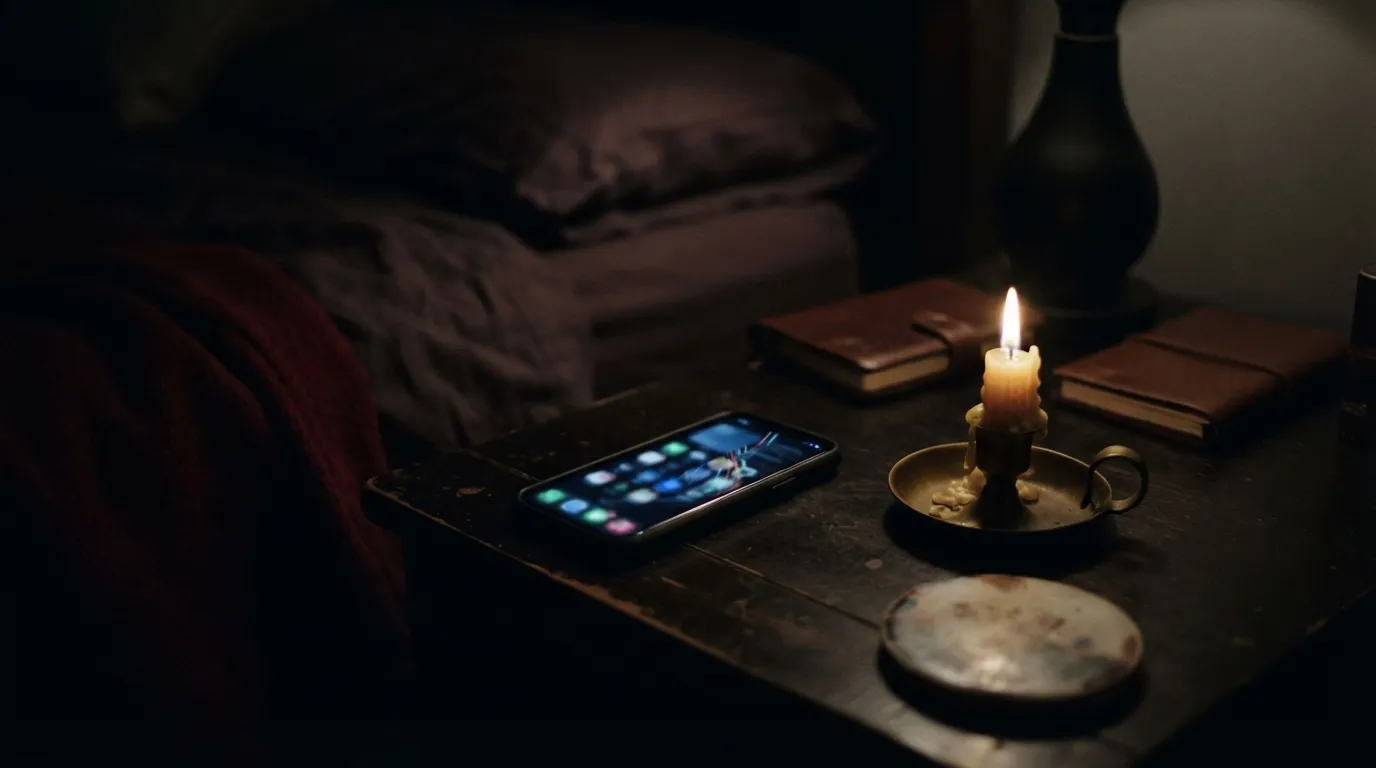
What you need: one light blue or white taper candle, a small piece of paper and a pen, a pinch of dried lavender or chamomile, and a quiet half hour where you will not be interrupted.
- Write the conversation you want, not the one you are afraid of. On the paper, write a short, honest sentence describing what you want to happen: “I want us to talk calmly about what happened, and really hear each other.” Avoid writing accusations or demands.
- Fold the paper toward you three times, and set it under the candle holder.
- Sprinkle the lavender or chamomile around the base of the candle, both known in herb lore for calm and clear speech.
- Light the candle and speak your intention aloud, plainly, in your own words. You are not casting a spell on the other person’s will; you are asking for the space between you to open.
- Let the candle burn down safely, never unattended, and keep the paper somewhere private afterward.
- Do not announce that you did this. Let the next conversation happen on its own terms.

Softening conflict before the hard conversation
Spiritual work clears the path, but the conversation itself still has to be carried by two human beings, and how you open it matters almost as much as whether you have it at all. A landmark study of divorcing couples found that communication problems were cited as a contributing factor by seventy percent of respondents, more than almost any other cause (Institute for Family Studies, summarizing Scott et al., 2013). The pattern that breaks relationships is rarely one huge fight. It is the accumulation of conversations that went badly, or never happened at all.
A few principles that pair well with the spiritual work:
- Open with the relationship, not the complaint. “I miss talking to you” opens a door. “You never talk to me anymore” closes one.
- Pick a calm moment, never mid-argument, never right after a trigger, never late at night when both of you are tired.
- Say what you want, not only what went wrong. “I want us to be able to talk about hard things without it turning into a fight” lands differently than a list of grievances.
- Expect to listen as much as you speak. A conversation that only one person controls is not the kind of conversation this work is trying to reopen.
- Accept a slow start. The first real conversation after a long silence is often short and a little awkward. That is normal, not a failure.
What to say when you reopen the conversation
The right first line depends heavily on your situation, but a few patterns work across most cases, because they invite rather than pressure.
- “Can we find a calm time to talk? I don’t want to keep avoiding this.”
- “I’ve been thinking about us, and I’d like to understand how you’re feeling.”
- “I know things have been tense. I’d rather talk it through than let it sit.”
- “I miss how we used to talk. Can we try again, even if it’s awkward at first?”
Avoid opening with “we need to talk,” which research on couples’ communication consistently finds puts the other person on the defensive before a word of the real conversation is said. Avoid bringing up every unresolved issue at once; pick the one that matters most right now. And avoid any mention of spiritual work. Let the conversation stand on its own.

When your partner has gone quiet (stonewalling)
Some people do not raise their voice when a relationship gets hard. They go quiet, leave the room, or answer in one word until the conversation dies on its own. This is stonewalling, and it is one of the hardest patterns to work with, because the quiet partner often believes they are keeping the peace, while the other partner experiences it as being shut out entirely.
Communication work for a stonewalling partner usually focuses less on drawing out a specific conversation and more on easing the anxiety that makes silence feel safer than speech. Pushing harder against a partner who shuts down almost always backfires; it confirms, to them, that talking leads to more pressure. A calmer approach, paired with the spiritual work, tends to open more doors than persistence alone.
When a third party or outside pressure is part of the problem
Sometimes the silence between two partners is not really about the two of them. A meddling family member, a jealous friend, an ex who will not step back, or a new person who has entered the picture can all pull attention and loyalty away before a couple even gets the chance to talk honestly. A reading usually makes this visible fairly quickly: the conversation keeps circling back to the same outside voice, or one partner seems to be repeating someone else’s opinion rather than their own.
When that is the case, communication work is paired with clearing third-party interference, which loosens that outside pull so the conversation that follows is actually between the two of you, not a negotiation with whoever has been whispering in the background.
Texting and digital communication
Most of modern communication happens through a screen, and a lot of modern silence does too. A slow reply, a one-word text, a read receipt with nothing after it, can carry more weight than it deserves, especially once trust has already been shaken. A few practical habits help alongside the spiritual work: save anything emotional or important for a call rather than a text thread, where tone is easy to misread; resist the urge to send a second message when the first goes unanswered for a few hours; and if a text conversation starts going badly, a simple “can we talk about this on the phone instead?” often does more good than another paragraph typed in frustration.
Communication work does not distinguish between a conversation that happens face to face and one that happens over text or video call. The block it clears is the one keeping a person from wanting to respond at all, regardless of which screen or room the words travel through.
Communication work alongside therapy or counseling
Communication spells are not a replacement for couples therapy, and Baba Ali does not present them as one. Many clients do both at once: a counselor teaches the skills and structure for a hard conversation, while the spiritual work eases the fear, pride or resentment that makes those skills hard to use in the moment. If you are already in counseling and it is not moving as fast as you would like, that is not a sign it is failing. Spiritual work and professional guidance tend to support each other rather than compete.
Communication spells for long-distance relationships
Distance changes the texture of this problem. There is no body language to read, no shared room to sit in quietly together, and every gap in communication can feel larger than it would in person. Couples who were once easy with each other on the phone sometimes find that calls shrink to a few sentences, then to texts, then to silence with no single fight to point to.
For long-distance situations, communication work is usually paired with the broader long-distance love spell work, which addresses the strain of distance itself alongside the specific block on talking. Practical adjustments help too: a set time to talk rather than leaving it open-ended, voice or video instead of text for anything emotional, and patience with time zones and tired schedules rather than reading silence as rejection.
Pairing communication work with other love work
Communication spells rarely stand alone. A reading usually shows one or two other pieces that make the conversation stick once it starts.
- If the relationship has been damaged by a specific betrayal or long silence, heal a broken relationship work addresses the wound underneath the silence, not only the silence itself.
- If you are specifically working to rebuild something after separation or a serious falling-out, reconciliation spell work targets the fuller process of coming back together, with communication as one part of it.
- If arguments have turned sharp and bitter, sweetening work softens the tone before the harder conversation happens, so it starts from warmth instead of defensiveness.
A reading tells you which combination fits your case. Most people need more than one piece, and that is normal.
Timing, candles and herbs for communication work
Traditional correspondences for communication work lean toward the qualities of air and quick-moving energy: light blue and yellow candles for clear, calm speech; white for honesty between you; herbs like lavender, chamomile and a little mint for calm and clarity; and Wednesday, traditionally associated with messages and exchange, as a favored day to begin. None of this is a rule that overrides urgency. If your situation needs attention now, Baba Ali does not make you wait for a particular day.

A simple home altar for ongoing communication work needs very little: a candle in one of the colors above, a dish for herbs, a small notebook for petitions, and a quiet corner that is yours. Many clients keep this going for weeks after the formal work begins, lighting a candle before a conversation they are nervous about.
What communication spells cannot do
Honesty here matters more than almost anywhere else in love work. Communication spells cannot make someone say something they do not mean, cannot force a confession, and cannot promise that a hard conversation ends the way you hope. They cannot turn a partner who has genuinely decided to leave into someone who wants to stay and talk it through, and they are not a way to pressure someone who has clearly and repeatedly said they need space. If your partner has said no to contact and you find yourself wanting to go around that no, repeatedly and without their consent, that is worth sitting with honestly before any work begins.
If any part of your situation involves a partner who refuses to accept “no,” monitors you, or has threatened you or themselves, please contact the National Domestic Violence Hotline at 1-800-799-7233. That situation calls for safety first, not spiritual work, and Baba Ali does not take cases involving abuse or active danger.
Our post on love spells and free will explains these limits in more depth, including why they exist and why they protect you as much as the other person. A spell can clear a path. It cannot walk down that path for either of you, and it cannot replace the two of you choosing, each time, to speak honestly instead of retreating into old habits.
Communication work compared to communication skills alone
It helps to see plainly what spiritual work adds, and what it does not replace.
| Communication skills alone | Skills plus communication work | |
|---|---|---|
| What it changes | Your own words and timing | Your words, timing, and the resistance on the other side |
| Reaches fear and pride | Only gradually, through repetition | Eased more directly alongside the conversation itself |
| Reaches outside pressure | No | Clearing work loosens it |
| Typical first shift | Weeks to months of practice | Often 3 to 7 days |
| Still requires | Honest, calm conversation | Honest, calm conversation |
Neither column replaces the other. The spiritual work is not a shortcut around the conversation; it is what makes the conversation possible to have in the first place.
An illustration
This is a composite example, not a real client. A couple together four years had stopped having real conversations; every attempt to talk about the future ended with one partner going silent and the other raising their voice. A reading showed resentment on one side and genuine fear of conflict on the other, not a lack of love. Work began with easing that fear, followed by a short communication ritual on a Wednesday evening. Four days later, the quieter partner brought up, unprompted, something that had been bothering them for months. It was not a smooth conversation. There were long pauses, and one topic got set aside for another day. But it was a real conversation, the first in a long time, and over the following weeks the pauses grew shorter and the topics grew harder, which is itself the sign that something had genuinely shifted rather than simply calmed down for a night.
Signs the conversation is opening back up
Progress with communication work rarely looks like one dramatic breakthrough. It shows up in small shifts:
- Replies come faster, or a call lasts longer than it has in weeks.
- Your partner brings up a topic they used to avoid.
- A disagreement ends in a real conversation instead of silence or shouting.
- Small, ordinary updates start flowing again: what happened at work, what they had for lunch.
- The tone softens, even if the topic is still hard.
Our post on signs a love spell is working covers the broader pattern these small shifts fit into.

How long communication work takes
Most clients notice the first shift, a reply, a longer call, a softer tone, within 3 to 7 days. A full return to easy, honest conversation usually takes longer, often several weeks of both the spiritual work and real effort on both sides. Money-back guarantee: no change within 7 days, full refund. See the Refund Policy for details.
Which work fits your situation
If your relationship is active but quiet, communication work alone is often enough. If it has been damaged by something specific, pair it with healing or reconciliation work. If distance is the main strain, long-distance work addresses that layer too. A love reading is the fastest way to see which combination fits, rather than guessing.
Related reading: Communication Spells for an Ex: Reopening the Door to Conversation.
Questions about communication spells for love
Is a communication spell only for exes?
No. Most requests come from couples who are still together but have stopped talking honestly. If you are specifically reaching out after a breakup, our no contact and love spells guide covers that narrower case.
Can a communication spell make my partner say what I want to hear?
No. It clears the block that keeps them quiet or defensive. What they choose to say remains their own.
What candle color is best for communication work?
Light blue, yellow and white are the traditional choices for clear, calm speech and honesty between partners.
My partner shuts down every time we argue. Will this help?
Often, yes. Stonewalling usually comes from anxiety rather than indifference, and easing that anxiety is typically the first part of the work.
Does this work for long-distance relationships?
Yes, often paired with long-distance love work that addresses the strain of distance alongside the communication block itself.
Should I tell my partner I did a communication spell?
No. Let the next conversation happen on its own terms, without mentioning the spiritual work.
How is this different from reconciliation work?
Communication work reopens honest dialogue. Reconciliation work addresses the fuller process of coming back together after a serious break, often using communication work as one piece of it.
What if nothing changes?
Clients are asked to watch for the first signs within 3 to 7 days. If you don’t, you get a full refund under the Refund Policy.