Here is how to cast a love spell at home without harm: keep it about you, not another person. Light one candle on a fire-safe surface, say a clear, honest intention about the love you want to open up to, sit quietly for ten minutes, snuff the flame, then take one real step toward what you asked for.
This guide walks through the whole ritual. It covers what a home love spell is and is not, the materials, moon timing, each step in order, fire safety, what never to do, realistic expectations, common mistakes, and when it makes more sense to ask an experienced practitioner for help.
What does it mean to cast a love spell?
A love spell, at its simplest, is a focused act of intention. You pick a small set of symbols, such as a candle, a color, a few spoken words and a quiet room, and you use them to say clearly what you are asking for. The ritual does not rewire anyone’s heart. What it does is give your own attention a shape, which most of us need when we are tired of drifting through the same dating patterns.
Traditions disagree about what happens beyond that. Some practitioners understand the candle as a prayer offered to spirits, saints or ancestors. Others see it as a way to focus the will. Others treat it as psychology wrapped in ceremony. A home ritual works inside any of those views, which is one reason it is a good place to start.
The spell in this guide is self-directed. It is for opening yourself to love and treating yourself with the care you hope to receive from a partner someday. It uses no other person’s name, photo or belongings. That choice is deliberate. Spells aimed at a particular person raise questions of consent that deserve to be taken seriously, and we cover them in love spells and consent and love spells and free will.
Is a home love ritual right for you?
This kind of ritual fits you well if any of these sound familiar:
- You are single and ready to meet someone, but you keep putting it off.
- You are recovering from a breakup and want to feel like yourself again before you think about anyone new.
- You are in a relationship and want to invite more warmth, patience and play into it.
- You are curious about candle work and want a gentle, low-risk way to try it.
It is better to wait, or to do something else first, in a few situations. If you are hoping to change one particular person’s mind, a home ritual is the wrong tool, and the section on what never to do below explains why. If you are in acute distress and cannot sleep or eat, talk to a friend, a doctor or a counselor before anything else. A candle is not treatment, and feeling hopeless is different from feeling sad. If small children or pets can reach the table, pick another day or another room.
If the breakup is recent, you may want to read about spiritual practices after a breakup and self-love rituals first. Both are slower and quieter than a candle spell, and many people find they need that before they need anything else.
What materials do you need?
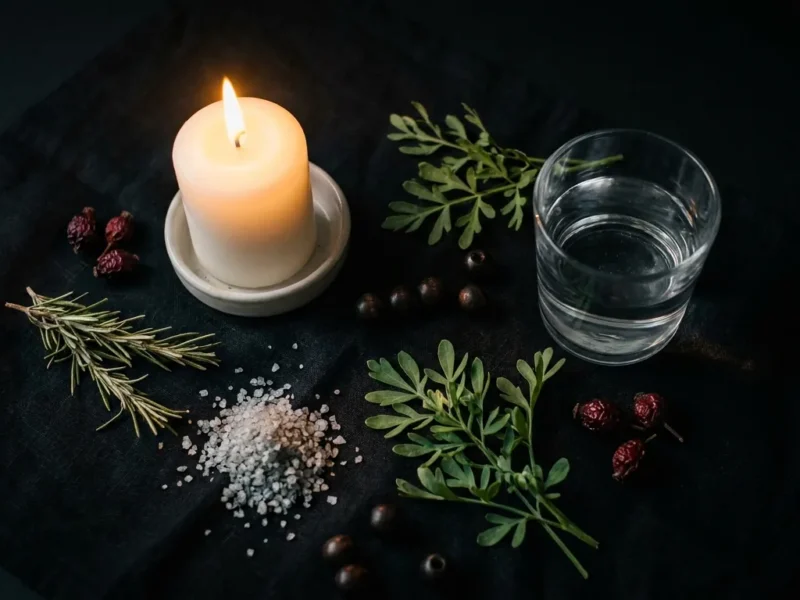
You do not need a kit. Spiritual shops sell elaborate sets, but a tea light from the grocery store and a pen do the same work. Here is a plain list:
- One candle. Pink is the usual color for self-love and gentle romance, and white suits any intention. A tea light in a metal cup, a small votive in a glass holder or a chime candle all work for a first ritual. If you would like to choose a different color, see candle colors in love magic.
- A heat-proof plate or tray, ceramic or metal, to stand the candle holder on.
- Matches or a lighter, and a candle snuffer or a metal spoon to smother the flame.
- A pen and a small piece of paper for your intention.
- A bowl of water or a damp cloth within reach, just in case.
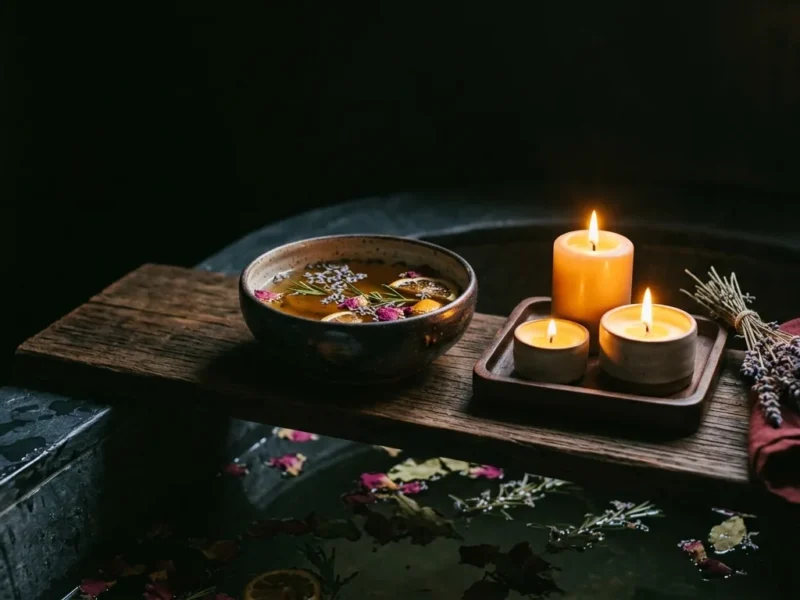
- Optional: a drop of olive oil to dress the candle, a few dried rose petals or a small rose quartz stone set beside the plate (never under or near the flame), and a cleansing bath beforehand. Our cleansing baths guide explains how.
Keep the list short. Every extra herb, ribbon or charm near a flame is one more thing that can catch. If you want to know what an ingredient means before you buy it, the spell ingredients glossary covers the common ones. For the wider craft of dressing, timing and reading a candle, the candle magic guide goes deeper than this post can.
When is the best time to cast?
Timing is optional, but it gives the ritual a rhythm. The moon takes about 29.5 days to go from one new moon to the next, as the Wikipedia article on lunar phases explains, and traditional practice splits that cycle into working halves.
- The waxing moon, from new moon to full moon, is for building and inviting. Self-love and opening to love belong here.
- The full moon is the peak. It suits gratitude, celebration and completing something you started. Our post on full moon love rituals covers that night in detail.
- The waning moon, from full back to new, is for releasing and clearing. It is a better time for a cleansing bath or for writing down old patterns you want to let go than for inviting something new.
For this ritual, the best window is the first week or so after the new moon, while the light is growing. If the moon is waning when you read this, use the time to tidy your space and think through your intention, then cast when the next waxing phase begins. The moon phases and love work guide has a fuller breakdown.
Day and hour matter less. In the Western planetary tradition, Friday belongs to Venus, the planet of love, and the Latin name dies Veneris still echoes in the French vendredi. Evening is popular because the house is quiet and the flame is easy to see. None of that is required. A focused ritual on a Tuesday afternoon will do more than a perfectly timed one done while you scroll.
As for frequency, one ritual per moon cycle is plenty. Some traditions repeat the work on three nights in a row, and that is fine if you stay calm about it. Repeating it several times a day is a sign that hope has turned into worry, and worry does not respond to candles.
How to cast a love spell at home, step by step
This version takes about twenty minutes. Read it through once before you begin, so you are not checking the page with a lit candle beside you.
Settle the room and yourself
Clear a small table or shelf. Remove loose paper, tissues, cloth and anything else that burns. Put your phone on silent in another room. Wash your hands and face, or take a bath if you have time. Tie back long hair, and avoid loose, dangling sleeves near the flame. Sit where you can see the candle without leaning over it.
Write your intention
On the paper, write one to three sentences in the present tense. Keep them about you, keep them positive, and leave out any name. “I am open to love” works better than “I want someone to stop being afraid of me.” Avoid deadlines, too. Love does not run on your calendar, and a deadline only gives you something to be disappointed about.
Here is a sample you can borrow or change:
I am open to a loving, honest and mutual relationship. I treat myself with the care I hope to receive. I am ready to meet love, and I welcome what is good for me.
If you are already in a relationship, you might write: I invite warmth, patience and play into my home. When you finish, fold the paper toward yourself. The old teaching is that folding toward you draws the intention in.
Prepare the candle
Hold the candle for a moment and read your sentence silently. If you are using a taper, votive or chime candle, you can dress it. Put a drop of olive oil on your fingertip and rub the candle from the top toward the middle, then from the bottom toward the middle. Wipe off any extra, and keep oil off the wick. Skip this step with a tea light.
Set the candle in its holder on the heat-proof plate. Place the folded paper at least an arm’s length away, never touching the plate or the holder.
Light the candle
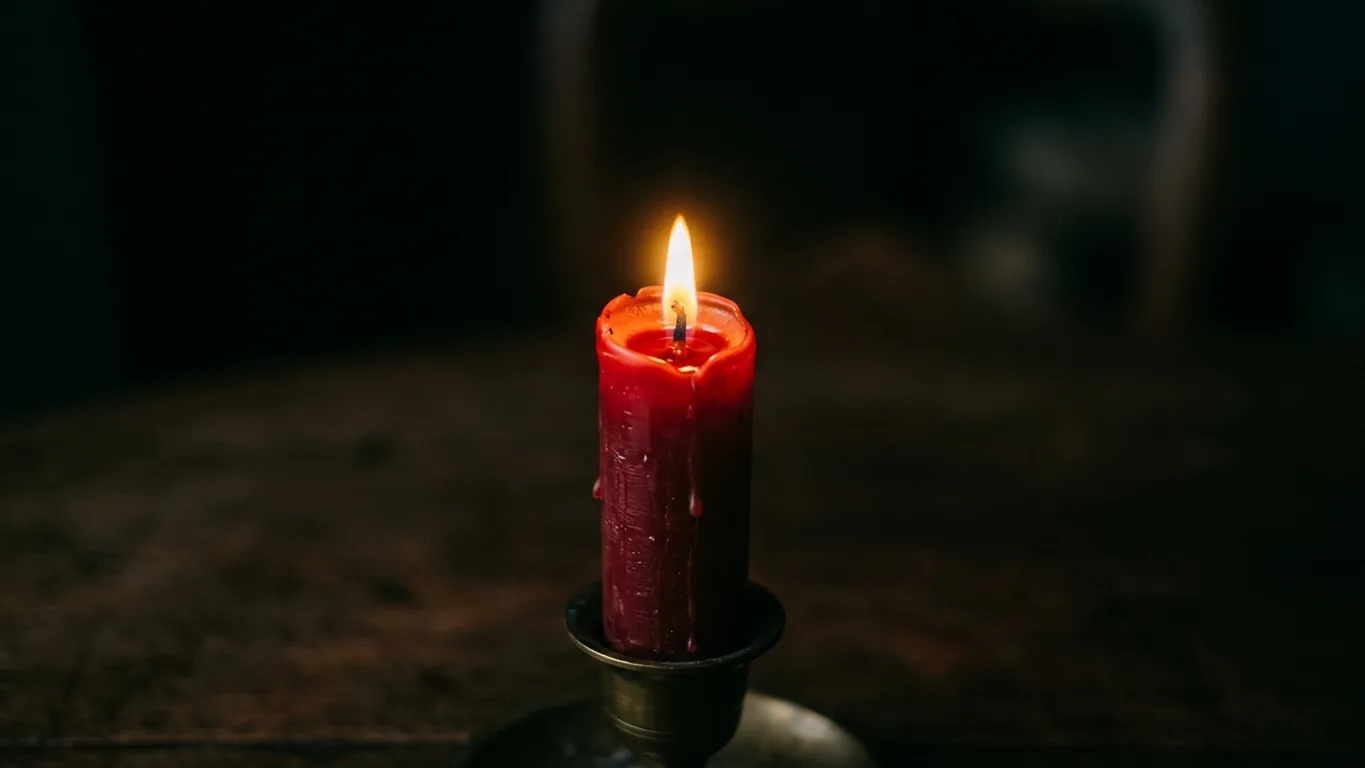
Strike the match or lighter and light the wick. As you do, say something simple, such as: “I light this candle to open my life to love.” Take a slow breath. Watch the flame settle. If it flickers hard, check for a draft, and move to a spot with still air.
Say your words
Pick up the paper and read your intention aloud, slowly, three times. You do not need a dramatic voice. A calm, ordinary one is better. If saying it aloud feels awkward, that is normal. Say it anyway, and notice which words catch in your throat. Those words often point at the real work.
Put the paper back in its place, away from the flame.
Sit with it
Spend about ten minutes in quiet. Breathe slowly and look at the flame. Picture an ordinary scene that holds the feeling you want: being at ease, laughing with someone, being listened to, coming home and being glad to be there. Do not picture a specific person’s face. Picture the feeling.
If doubt shows up (“this is silly,” “nobody will want me”), do not argue with it. Name it, let it sit beside you, and come back to the flame. A doubt you can see is easier to work with than one running in the background.
Close the ritual
Say thank you. You can thank the light, your ancestors if that is part of your tradition, or simply yourself for showing up. Then say something like: “This is done. I release it.” Snuff the candle with a snuffer or the back of a metal spoon rather than blowing it out. Blowing can spray hot wax and scatter sparks. Check that the wick has stopped glowing, and leave the holder on the plate until it is cool to the touch.
Keep the paper somewhere private, in a drawer or between the pages of a book. Do not burn it in the house.
Take one real step
Within two days, do one thing that matches what you asked for. Say yes to an invitation. Message a friend you have been meaning to see. Update a dating profile with a photo you like. Sign up for a class. Book a session with a counselor. The ritual sets the direction, and the step is how you walk it. For ideas on what to do next, read what to do after a love spell is cast.
How do you keep the ritual fire safe?
A lit candle is an open flame, and no tradition asks you to risk your home. The National Fire Protection Association publishes clear candle safety guidance, including keeping candles at least 12 inches from anything that can burn and never leaving one burning when you leave the room or go to sleep. Read it before your first ritual. In practice, that means:
- Stay in the room for as long as the flame is lit.
- Use a stable holder on a heat-proof plate, on a flat, steady surface.
- Keep the flame well away from curtains, paper, clothing, books, bedding and hair.
- Keep candles out of reach of children and pets, and out of drafts.
- Trim the wick short before lighting a taper or votive.
- Never burn a candle in bed or while you are drowsy.
- Snuff the flame completely, and check it again before you leave the room.
- Make sure your smoke alarm works.
Some older teachings say a candle must burn all night or burn down to the last of the wax. Candle lore is older than smoke alarms, and the intention survives a sensible adjustment. Use a tea light you can watch until it finishes, or light the candle for a set time and snuff it. If you want a glow that lasts, an LED candle is a fine stand-in for the hours you cannot supervise.
What should you never do?
A home ritual is gentle because it is limited. These are the lines to keep.
Do not aim it at a specific person
Do not use another person’s name, photo, hair, clothing or handwriting in a ritual you do at home. A spell meant to make someone feel or act differently is an attempt to steer a person who has not agreed to it. Even when the wish comes from real love and real hurt, it asks for something that is not yours to take. It also tends to backfire on the caster, who ends up fixed on one outcome and unable to see anyone else. Our guides on consent and love spell ethics explain the thinking in full.
Do not do obsession work
Obsession work is any ritual repeated to keep one person on your mind, or you on theirs. It includes daily candles “to make him think of me,” spells to find out what someone is doing, and rituals you add each time you feel anxious. If your ritual makes you check someone’s social media more often, stop. The point of the work is to open you to love, and obsession closes you around one door.
If someone in your life follows you, monitors your phone, shows up where you are without being asked, or will not accept no, and you feel unsafe, a candle will not help. Please call the National Domestic Violence Hotline at 1-800-799-7233, or visit thehotline.org.
Do not work against a couple or take revenge
No ritual to break up a relationship, to make a rival unhappy or to punish a former partner belongs in a love practice. Black candles are sometimes used for protection and clearing, but cursing is not love work, and it has no place in a first ritual.
Do not cast in the wrong state
Do not do this after drinking, in the middle of a fight or in the hour after bad news. Your intention will carry whatever you carry into the room. Wait until you are calm enough to mean what you write.
Do not let the candle replace real life
Do not skip a doctor, a counselor or a hard conversation because you lit a candle. Do not ignore red flags in a partner because a ritual “should” have fixed things. And do not hand over money to anyone who says you are cursed and only they can lift it. Our guide to scam warning signs and the post on how to choose a real love spell caster list what to watch for.
What results are realistic?
A candle ritual at home is not a switch. It will not summon a stranger to your door, and it will not make a particular person call. Anyone who tells you otherwise is selling something.
What it can reasonably do is smaller and more useful. You get clearer about what you want. You feel calmer about the wanting. You become a little more willing to say yes, to start a conversation, to leave a pattern that was not working. Some people also report that opportunities show up in the weeks that follow. A skeptic will say you started paying attention. A practitioner will say both can be true, and that attention is part of how the work operates.
Give the ritual a full moon cycle, about a month, before you judge it. Look for inward changes first, such as less dread, more energy, easier sleep and a stronger sense of your own worth. Outer changes tend to follow your actions, not your wishes. Our posts on how long a love spell takes to work and the signs a love spell is working give a fuller picture of what to look for and what to ignore.
If nothing changes, that is information, not failure. Your intention may have been vague. Your circumstances may need action more than ritual. Or the situation may need a more experienced hand, which is covered at the end of this guide. Why some love spells fail goes through the usual reasons. Nobody can honestly promise a result, and a person who does should make you more careful, not less.
What are the most common mistakes?
- Writing an intention that is too vague. “I want love” gives you nothing to hold. “I am open to a mutual, honest relationship” does.
- Writing an intention that is too specific, with a name, an age, a job and a date. You are asking for a script, not a relationship.
- Turning it into a worry habit by repeating the ritual every time you feel low.
- Doing the ritual and then changing nothing. If you stay home every night, the spell has no door to open.
- Judging the whole thing by one bad date or one quiet week.
- Checking for signs every hour. Watching for results is another way of being anxious.
- Buying a long list of tools and then feeling the ritual is incomplete without them.
- Rushing through it on your phone’s schedule, with notifications buzzing nearby.
- Treating fire casually. A ritual that burns the curtains has failed in every sense.
- Comparing your ritual with someone else’s. Candle work is personal, and a quiet version still counts.
Most of these come down to one thing: expecting the ritual to do the work that only you can do. The candle is the beginning of a conversation with yourself, and the days that follow are the rest of it.
When should you ask an experienced practitioner instead?
A simple candle ritual is a good tool for opening yourself to love. It is not the right tool for everything. Consider asking for help if any of these fit:
- You want to work toward a particular person, such as an ex or a partner who has pulled away. This needs a conversation about consent and fairness first, and it is outside what you should do alone with a tea light.
- Your grief or heartbreak is not easing after weeks, and the same patterns keep repeating.
- You feel blocked, crossed or weighed down in a way you cannot explain, as if bad luck in love has become a habit.
- A home ritual left you more anxious than before.
- You want work grounded in a specific tradition and do not want to borrow pieces you only half understand.
Baba Ali Musa has worked in love consultation for more than 30 years, in a Senegalese ancestral lineage, and works with clients across the USA by WhatsApp, phone, email and video. A good practitioner asks questions before promising anything, tells you honestly what a spell can and cannot do, and does not try to control another person. Depending on what you need, the closest fit might be a guided love candle ritual, an attraction spell to open the way to new connections, or Voodoo love spells in the ancestral tradition. If you suspect something is standing in the way, uncrossing and cleansing for love deals with that directly. And if you are not sure what you need, a love reading consultation is a place to start.
If you want to understand the tradition behind some of this before you decide, what is Voodoo is a plain introduction. Whoever you choose, you can count on a clear policy: Money-back guarantee: no change within 7 days, full refund.
Money-back guarantee: no change within 7 days, full refund.
- Private & confidential
- Adults 18+ only
- Discreet billing
Questions people ask about casting a love spell at home
Can I cast a love spell on my own without a spell caster?
Yes. A simple candle ritual for self-love or opening to love needs no outside help, only a candle, a safe surface and an honest intention. Work aimed at another person, or at repairing a relationship, is better handled with an experienced practitioner.
What is the safest love spell to do at home?
A single candle ritual focused on yourself is the safest, spiritually and physically. It involves no other person, no obsession and very little equipment. Keep the candle supervised on a heat-proof plate, and snuff it when you finish.
Can I cast a love spell on a specific person at home?
We advise against it. A spell that names someone who has not agreed to it raises real consent problems, and it often feeds fixation. If you want to work toward a particular person, talk to a practitioner who puts consent and fairness first.
What is the best time to cast a love spell?
The waxing moon, from new moon to full, suits work that invites love in. Fridays are traditionally linked with Venus, and evenings are quiet. None of it is required. A focused ritual on an ordinary day works better than a perfectly timed, distracted one.
How long should the candle burn?
For a first ritual, 15 to 25 minutes is plenty. Light it, speak your words, sit quietly, then snuff it. Never leave a candle burning while you sleep or leave the house. If a tradition wants a candle burned fully, use a tea light you can watch.
How long until a home love spell works?
Judge it over about one moon cycle, roughly a month, not a day. Early changes are usually inward: clearer wants, calmer nerves, more willingness to say yes to invitations. Outside results depend on your actions and circumstances, and no honest practitioner can promise a date.
Is it safe to leave the candle burning overnight?
No. Fire safety groups such as the NFPA advise never leaving a burning candle unattended and never burning one while you sleep. Snuff it at the end of your ritual. The intention does not depend on the wax burning all the way down.
Do I need to follow a particular religion or tradition?
No. Candle work appears in many traditions, including Catholic devotion and Hoodoo, and a simple home ritual does not require initiation into any of them. Use words that feel honest to you, and respect the traditions you borrow from.