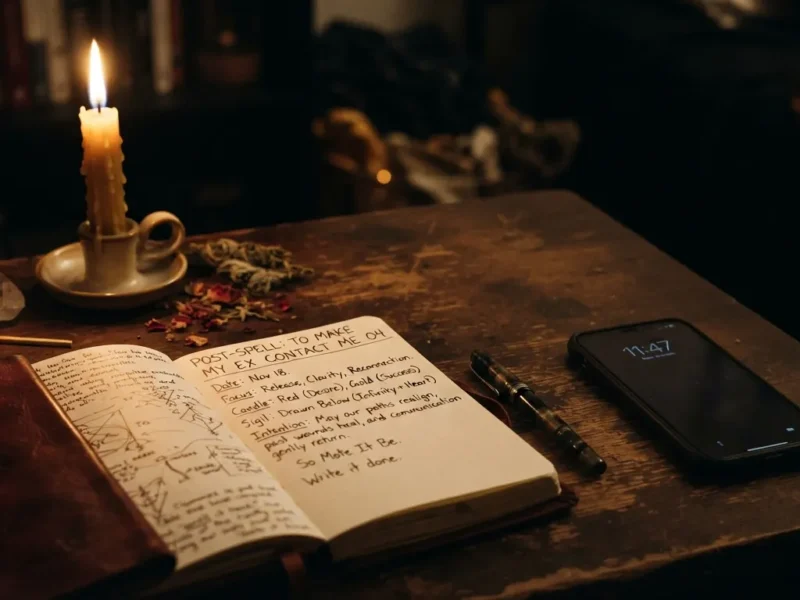
Love spells and consent come down to one test: does the work leave the other person free to say no and mean it? If yes, it belongs in a respectful practice. If the request only makes sense when the other person has no say, it does not, and a responsible practitioner turns it down.
That test decides which cases Baba Ali Musa accepts, which ones he ends after the first conversation, and why some people leave a consultation without the work they came for.
This guide is about consent in particular: who you may ask for help about, what changes when a person has already said no, how third parties fit in, and which requests are refused outright. If you want the larger philosophical question of whether any ritual can touch another person’s choices, read love spells and free will first. This page is the practical companion. It deals with the specific people, situations and messages that decide whether work goes ahead.
What consent means in love work

In ordinary life, consent means a person has been told what is happening and has agreed to it freely. Love work complicates that, because the person at the center of most requests is not in the room. They do not know a consultation is happening. They have not been asked. So what could consent possibly mean?
In Baba Ali’s practice it means three things, and all three have to hold.
First, the work never takes the decision out of the other person’s hands. A ritual may soften pride, clear confusion, calm anger or reopen a door that was closed in a hurry. It does not walk someone through that door. What they do next, they do as themselves. That is the dividing line between influence and control, and it is why the work is described as opening a path rather than pushing a person down it.
Second, a clear refusal from the other person ends the request. If the person you are asking about has told you, in words, that they want no contact, want no relationship, or want you to stop, their answer counts. Spiritual work does not get to overrule a stated no. This is the rule people find hardest, because it often arrives at the exact moment they are most desperate.
Third, the client consents too. You should know what is being done, what it costs, what it cannot promise, and that you can stop at any point. Consent is not only about the person who is absent. It also covers the person who is paying and hoping.
That is the difference from the free will discussion. Free will asks whether anything we do can touch another person’s choices at all. Consent asks something more usable: given that we are about to try, what must be true first? Whose permission matters, whose refusal matters, and who else is affected?
The three people in every request
Most people picture a love request as two people: the client and the one they want. In practice there are almost always three groups, and consent applies to each of them differently.
The client
You are the person asking, and you are entitled to straight answers. That includes the honest answer that a spell cannot promise a particular outcome, that results depend on the other person and on circumstances, and that some situations are better served by a conversation, a boundary or time than by ritual. A practitioner who tells you only what you want to hear is not respecting your consent. He is spending your hope.
The person named in the request
This is the ex, the partner, the crush, the spouse. Their consent cannot be collected in a consultation room, so the practice replaces it with limits. The work stays within the connection between you and them. It leaves their daily choices alone. It stops entirely if they have made their wishes clear. And no work is ever done to hurt them, frighten them or make them ill, whatever the client feels at the time.
Everyone else
New partners, rivals, children, family members, a spouse on the other side of a divorce. They did not ask to be part of your story, and some of them are affected by whatever happens. The practice treats them as people with their own claims, not as obstacles. More on this below.
Holding all three in view is what makes a consultation slower than people expect. The questions are not a formality. They are the consent check.
Who you may ask for help about

The simplest category is you. Work on your own heart, your own readiness, your own patterns, your own protection and your own ability to love and be loved is always fair. No one else’s choices are involved. This is also the most underrated place to start, because many people who come about an ex are carrying something unresolved in themselves that no amount of work on the other person would fix.
After that, the answer depends on the relationship.
A partner you are currently with
Work to strengthen a bond, sweeten a tense season, restore warmth after a fight or deepen commitment is within bounds when the relationship is real, mutual and safe. A honey jar sweetening spell or a commitment spell asks the connection between you to grow warmer. It does not stop your partner from leaving if they truly want to. If that last sentence bothers you, it is worth sitting with before booking anything, because it tells you whether you want a relationship or a lock.
A spouse in a struggling marriage
A marriage in crisis is a legitimate reason to seek help, and work to stop a divorce or heal a broken relationship is within bounds when the situation is ordinary heartbreak. It is not within bounds when the marriage involves violence, threats or a protective order. In those cases the kindest thing a practitioner can do is decline and point toward real protection.
A person you have never really been with
Someone you work with, a friend, a person you have admired from a distance. Here consent is thin, because there is no relationship to restore and no history to read. Baba Ali will not do work aimed at a specific person who has shown no interest. Instead, attraction work can open you to love in general. An attraction spell or a soulmate spell does not name a target. It prepares you and lets the right person, whoever that turns out to be, find a way in.
Someone else, on behalf of a third person
A mother asks about her adult son’s relationship. A friend wants help for a heartbroken friend. A new partner wants to settle an ex’s feelings. These requests come from kindness, and they run into the same wall: the person at the center did not ask. Baba Ali works with the person who is actually living the situation. If your friend wants help, your friend books the consultation. You can encourage them. You cannot sign them up.
A person who has told you to stop
This is the next section, and it deserves its own space.
When an ex has said no
A breakup does not by itself close the door on this work. Many reconciliation cases begin exactly there. What matters is what the other person actually said, and how recently, and whether it was meant. Not every no is the same, and treating them all alike would be wrong in both directions.
Hurt, anger and “I never want to see you again” in the first weeks
Words said in the first days of a breakup are often real feelings and just as often pain talking. A practitioner cannot decide which. What can be done is wait. In cases like this, the honest advice is usually to leave a stretch of silence, let the first heat pass and see what remains. Our guide to no contact and love spells explains why that gap is often the most useful thing you can give the situation.
“I need space”
This is a request for distance with a time limit, even if no one said so. Honoring it is part of consent. Work during a space period is limited to calming your own side and clearing outside interference. It does not aim to pull the person back before they are ready. Pushing against a request for space tends to turn a pause into a goodbye.
“We are done, and I do not want to be contacted”
This is a clear boundary. The work stops being about reconciliation. Baba Ali will not do work to reopen contact with someone who has asked for none. What he can do is work with you on the grief, on releasing the attachment, and on opening your life to what comes next. People sometimes hear this as a refusal to help. It is a different kind of help.
A formal no: blocked numbers, a protective order, a request through a lawyer
A blocked number is a boundary, not a puzzle. A court order is a legal fact. A request through a lawyer or family member means the person has gone to some trouble to say it clearly. In none of these cases will spiritual work be done to cross the line. The practice declines the case, and that is not negotiable.
Silence and ghosting
Silence is not consent and it is not refusal. It is an absence of information. Many people who have been ghosted ask whether the silence means they may go ahead. It does not. It means you do not know yet. In these cases the useful work is usually on your side: steadiness while you wait, protection from the spiral of checking and guessing, and a love reading consultation to look honestly at what is going on between you instead of reading tea leaves out of a read receipt.
Mixed signals: they said no but they keep reaching out
If the other person says they are done and then likes your posts, replies late at night or turns up at the edges of your life, that is confusing and it is common. The honest approach is to ask them directly, and if they confirm they want distance, to believe the confirmed version over the ambiguous one. Work is considered only when the signals have settled into something that is not a stated refusal.
Requests a responsible practitioner refuses

Some requests do not need a long discussion. They are declined at the start. The reasons differ, but they share a thread: in each one, someone’s safety or clear choice would be given up to satisfy someone else’s wish.
- Cases involving anyone under eighteen, as client or as the person named.
- Requests to hurt, sicken, humiliate or frighten anyone, including an ex, a rival or a new partner.
- Requests to make someone unable to leave, unable to look at anyone else, or unable to function without the client.
- Requests to cut a person off from friends, family or work so that they depend on the client.
- Requests to make someone sexually available, or to lower someone’s guard so they will say yes to sex.
- Requests to make a person abandon their children, their home or their obligations.
- Any request involving a person who has stated, formally or plainly, that they want no contact.
- Any case where violence, threats or stalking is part of the picture, in either direction.
- Requests meant to monitor someone: to know where they are, who they are with, what they say in private.
- Breaking up a family or a marriage out of spite when the people involved are working it out themselves.
Looking at that list, notice what the refusals protect. Most of them protect the person who is absent. Some of them protect the client from themselves. A person who asks that someone become unable to leave is usually afraid of being left, and feeding that fear with ritual makes it larger. Declining is sometimes the best thing a consultant does for a client in the room.
Third parties and the new partner question
Where there is a new partner, the heartbreak is sharper and the ethical questions multiply. The client often wants something done about the other person, and the other person is a human being who has not wronged anyone by being loved.
The practice makes a clear difference between clearing interference and attacking a person. Clearing means working on the situation: the confusion, the tension, the outside voices that distort a decision. A third-party interference clearing addresses what is getting in the way of a connection. It is not aimed at the third person’s health, happiness or safety. No ritual is performed to make a new partner suffer, cheat, fall ill or lose their job. A client who asks for that is told no, kindly and once.
The hardest version of this is an affair. Someone’s partner is involved with another person, and the betrayed partner wants the affair to end. Here Baba Ali separates the pieces. Work on the betrayed partner’s own steadiness, clarity and protection is fine. Work to restore the damaged bond between the couple, if both were committed to it before, is fine. Work to harm the other person is not. And work that treats the unfaithful partner as an object to be recovered rather than a person who made choices is limited to what the connection itself can bear. If you are in this situation, our post on relationship interference explains how outside pressure and real conflict can be told apart.
What about a rival who really is doing harm?
Sometimes a third person is not innocent. An ex’s relative is working to keep two people apart. A coworker is spreading rumors. A former partner is interfering with a reconciliation. Even then, the work aims at protection and clarity, not punishment. You can shield a relationship from outside pressure without asking for anyone to be hurt. If the situation involves harassment or threats, the right step is to document it and bring in the people who can enforce boundaries: a lawyer, the police, a mediator.
Gray areas, and how they are handled
Real cases rarely arrive as neat categories. A few of the common gray zones are worth walking through, because the answers are not always where people expect them.
Should the other person be told?
People ask this sincerely. Some traditions and some practitioners say the person should know. Baba Ali’s position is that the ritual works on the connection and not on the person’s mind, and that the decision about whether to tell is yours. What he does insist on is that nothing is done in a way meant to deceive the person about the relationship itself. If your plan depends on them never discovering what you did, that is a signal to examine. Love that needs to stay hidden to survive is usually weaker than it looks.
Is a general attraction spell the cleaner option?
For many people, yes. Work that opens you to love and calls in someone who is free to choose you does not touch anyone’s consent, because no particular person has been selected. The tradeoff is honest: it does not promise that a specific person will return. That is also the point. If the goal is a relationship with someone who wants to be in it, work that leaves the other person’s choice intact is working in your favor.
What about a person I am already dating casually?
Casual dating is real, and it is also a place where intentions are often mismatched. Work to deepen a bond with someone who has said they are not looking for more is closer to pressure than to invitation. A better use of a consultation is looking at what they actually want and what you want, and whether they overlap.
Long distance, different cities, a partner who is busy
Work to support a long-distance connection is within bounds when both people want it to continue. Our long distance love spell addresses the practical drift that distance causes: missed calls, uneven effort, loneliness. It is not about holding someone in place who is quietly pulling away.
Same-sex and other relationships
Consent is the same in every relationship. The questions, the refusals and the limits apply in the same way. If you want to understand how the practice approaches these cases specifically, see the page on same-sex love spells.
How consent is checked in a consultation

A love reading consultation is not only a reading. It is where the consent questions are asked, and where a case can end. If you are wondering what the questions look like, here they are in plain terms.
- What is your relationship to this person, and what is it now?
- What was the last thing they said to you, in their words, and when?
- Are you in contact today? Who started it?
- Has there been any court order, blocked number, or request to stop?
- Has there been violence, threats or intimidation, in either direction?
- Is anyone under eighteen involved?
- Are you asking for yourself or on someone’s behalf?
- What outcome are you hoping for, and what would you do if the answer is no?
The last question matters more than people realize. If the answer is “I would not accept no,” that is where the conversation changes, and not in the client’s favor. A person who cannot imagine a no is not ready for this work. They need support first.
Some consultations end there. A reading that ends in a refusal is not billed. The refusal is delivered calmly, with the reason, and with some practical direction if there is any to give. People are sometimes angry in the moment. Some write back later to say it was the honest answer they needed.
If you are curious about what a consultation looks like in practice, our love spell consultation guide walks through what to bring and what to expect.
When the real problem is control
This is the part nobody enjoys writing, and it is necessary. Some of the people who ask about love spells are not heartbroken. They are controlling, or they are being controlled, and the ritual question is a way of approaching something that needs different help.
Signs that a request is about control rather than love include these: needing to know where the other person is at all times, becoming angry or frightened when they have friends, refusing to accept a breakup after being told clearly, showing up uninvited, contacting people around them to find out what they are doing, or feeling entitled to a relationship that the other person has ended. If that sounds familiar, even a little, the answer is to stop pursuing and seek support.
The National Domestic Violence Hotline notes that abuse can intensify when a partner feels they are losing control, and its guidance on stalking and safety planning explains why refusing to accept an ended relationship is treated as a safety issue and not a romantic one. If you are afraid of someone, or someone is afraid of you, call 1-800-799-7233. The line is free and confidential, and it helps people on both sides of these situations find a next step.
Love work is not a replacement for that kind of help. No candle, jar or prayer makes an unsafe situation safe, and a practitioner who suggests otherwise is putting you at risk.
Consent for the person asking
We have talked a lot about the absent person. The client’s consent matters just as much, and it is where some of the worst practices in this field show up.
A fair consultation tells you what the work is, what it costs, and what it cannot do. It does not pressure you with deadlines like “the moon is leaving tonight.” It does not hint that your ex will suffer if you walk away. It does not tell you that your problem is a curse that only an additional payment can lift. It does not ask you to hand over private photos, passwords or access to someone else’s accounts. And it lets you leave at any point, with no fee for the part you did not take.
If you want a checklist for spotting the opposite, read the guide on scam warning signs. If you are comparing practitioners, how to choose a real love spell caster covers what honest practitioners say and what they refuse to say. Baba Ali’s own commitments are set out in the love spell ethics guide and the Ethics Charter.
A five-question consent check you can run yourself

Before you book any kind of work, with Baba Ali or with anyone, ask yourself the following. Write the answers down. They are for you, not for a practitioner.
- What did they actually say? Not what you think they meant. The exact words and the date.
- Would I be comfortable if they read what I am planning? If the idea only works in secret, look at why.
- Am I asking for a door to open, or for a person to be moved? The first is invitation. The second is control by another name.
- What will I do if they still say no? If the honest answer is “keep going,” pause and talk to someone you trust before anything else.
- Who else is affected? A new partner, children, family. If your plan only works by hurting them, it needs rethinking.
Most people find that two or three of these questions shift what they were going to ask for. That is a good outcome. Many leave with a better request than they arrived with, one that respects the other person and has a real chance of being heard.
What respectful work looks like when the other person said no
Suppose your ex ended things clearly and asked for space. There is still a lot that can be done, and none of it breaks consent.
You can do the work on your side: grief, anger, release, and the steadiness that stops you from texting at two in the morning. You can have protection work done so that other people’s opinions and interference do not make things worse. You can use the quiet months to change the things that contributed to the breakup, because if the same patterns return, the same ending will too.
After some time has passed, if you still want to try, the respectful route is a single honest, low-pressure message that asks nothing of them, which they are free to ignore. Our guide on how to reopen communication after no contact covers how to word it. If they answer warmly, there is a conversation to have. If they do not answer, that is also an answer, and the respectful thing is to take it.
When both of you are willing, reconciliation work has a real foundation. A reconciliation spell works on the bond between two people who still have something between them. It is not a way to start a bond that the other person has closed. If you want to understand where the line falls for an ex who has moved on, our post on reconciliation when an ex has moved on looks at that exact case.
Why the line protects you too

It is easy to read all of this as restrictions that protect other people at your expense. It is closer to the opposite. A relationship produced by pressure does not feel the way you imagine. If someone were somehow made to stay, you would spend the relationship wondering whether they would be there if they had a choice. That doubt is a quiet cost, and people pay it for years.
The other benefit is simpler. When work stays within consent, the outcome, whatever it is, is something you can live with. If they come back, they came back as themselves. If they do not, you are not left with the sense of having done something you cannot take back. That is a better place to start a new chapter.
The aim is not a spell that works by overpowering someone. It is a situation in which two people, each free to choose, choose each other. Everything else in this guide is a way of keeping that possibility honest.
Frequently asked questions
Do I need my ex’s permission before a love spell is cast?
Their permission cannot be gathered in a consultation, so the practice uses limits instead. The work stays within the connection between you, never touches their daily choices, and stops if they have clearly said they want no contact. If the person has asked you to stay away, the case is declined.
Can I ask for a spell on behalf of a friend or family member?
No. The person living the situation needs to be the one who asks, because they are the one who can say what they want and what they would refuse. You can encourage a friend to book a consultation. You cannot book it for them.
What if my ex blocked me or said they never want to hear from me?
That is a clear boundary, and no work is done to reopen contact. What can be done is work on your own grief and on opening your life to new love. If a court order is involved, the case is declined outright.
Is an attraction spell more ethical than naming a specific person?
It is simpler on consent, because no one has been selected and anyone who comes into your life remains free to choose you. The honest tradeoff is that it does not promise any particular person will return. For people who want a real, willing partner, many find that is a fair trade.
Does the other person have to be told about the spell?
Not as a rule. The ritual works on the connection and not on a person’s mind, and whether to tell them is your decision. What the practice does ask is that you are not trying to deceive them about the relationship itself, and that you stop if they say they want you to.
What happens if a consultation ends in a refusal?
The reading is not billed. You are told plainly why the work is being declined, and where it makes sense, pointed toward practical help: a counselor, a lawyer, or a support line. Some people are frustrated at first. Others come back later to say it was the honest answer they needed.
I am afraid of my ex or my partner. Can a spell help?
Please start with human help. Call the National Domestic Violence Hotline at 1-800-799-7233, or text START to 88788. A spell is not a safety plan. Protection work can sit beside real safety steps, but it never replaces them.
How is this different from the free will question?
Free will asks whether anything we do can touch another person’s choices. Consent asks what must be true before work begins: whose wishes count, which cases are refused, and who else is affected. If you want the first question, read our post on love spells and free will.
Where to go from here
If your situation fits inside the lines described here, a love reading consultation is the right first step. It looks honestly at where you and the other person stand, and tells you whether work is appropriate and what kind. If you and your former partner both still want to try, a reconciliation spell is built for exactly that. And if your situation does not fit, you will hear that too, calmly and with reasons.
The line is not there to make your life harder. It is there so that whatever happens between you and the person you love, it happened between two people who were both free to choose.