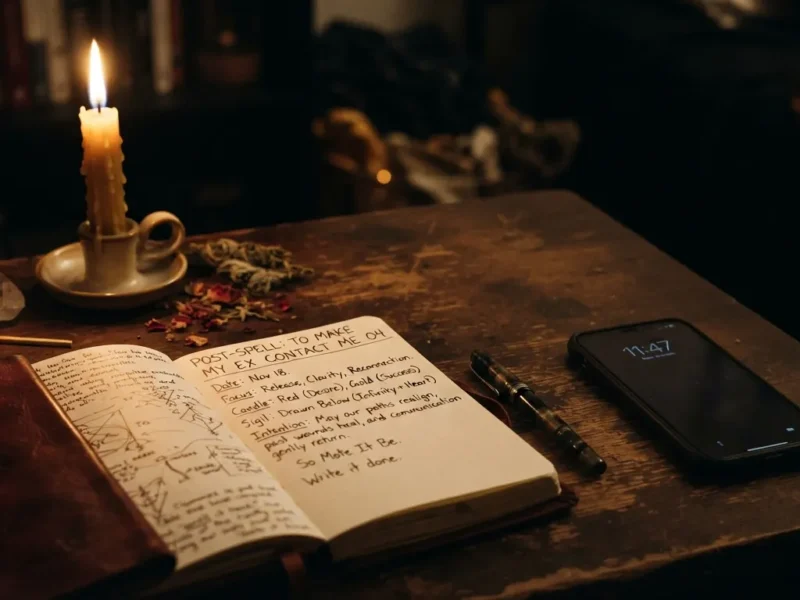
An obsession spell is work sold to make one person fixate on another until they cannot stop thinking about them. Baba Ali Musa does not cast an obsession spell. Obsession is not love, it harms the person it targets, and it harms the buyer too. He offers work that warms attention and leaves the other person free to choose.
This page explains what sellers mean by the term, why a fixation is the opposite of affection, what the risks are for the target and for you, how the scams around it operate, and what Baba Ali does instead. If you came here because you want someone to think about you, there is practical help near the end.
What is an obsession spell?
The phrase covers a family of requests that sound different but share one aim. A caster is asked to make a particular person think about the client all day, lose interest in everyone else, feel restless or sick until they make contact, or be unable to sleep without the client on their mind. Sellers go by many names: come-to-me spells, crazy-in-love spells, possession work, domination work. The label changes. The goal does not.
What all of them target is the other person’s mind, not the relationship. A reconciliation or devotion request asks for warmth between two people and leaves each of them standing in their own life. An obsession request asks for one person to stop standing there. It wants the choice gone, because the choice is the part that hurts: the person might say no.
The request usually arrives at a bad moment. Someone has been dropped or left on read for a week, and the pain is loud. A spell that promises to make the other person feel the same pain sounds like relief. That is understandable. It is also the pain doing the shopping, and pain is a poor buyer.
This is why Baba Ali declines these requests in the first conversation. The same refusal is written into the list of cases he will not take, which you can read in love spells and consent: any work meant to make someone unable to leave, unable to look at anyone else, or unable to function without the client. The wider principles behind that refusal are in the love spell ethics guide, and the line between gentle and harmful work is covered in white magic versus black magic love spells.
Why do people ask for one?
Under the request there is nearly always a reasonable wish. You want to be chosen. You want the uncertainty to end. You want the person who left to feel the weight of what they did, or at least to notice that you are gone. None of those wishes is shameful. They are what a heart does when it is hurt and cannot find the exit.
The trouble is the tool. Being chosen needs a person who is choosing. An end to uncertainty comes from an answer, and a person who cannot stop thinking of you is not in a position to give one. Each of these wishes has a better route, and most of this page is about those routes.
Why obsession is not love
Love has rest in it. You can think about someone you love, then think about dinner, your job, a song on the radio, and come back to them without alarm. Obsession has no rest. It is a thought that arrives uninvited and will not leave, often with a tight chest, repeated checking of a phone, replayed conversations and a jealousy that has no particular target. Anyone who has been through a bad breakup knows a mild version of it. It is miserable. Nothing about it feels like being cherished.
Films dress this up as devotion. In real life the person living it is not happy, and the person on the other end is not flattered. They are worn down, or frightened.
Researchers have a name for the behavior side of this. Brian Spitzberg and William Cupach, who studied it, called it obsessive relational intrusion: repeated, unwanted pursuit of closeness that invades another person’s privacy. The behaviors range from endless calls and texts to showing up uninvited, and stalking sits at the severe end. The Wikipedia entry on obsessive relational intrusion describes the idea in more detail. That research is about human behavior, not spells. It matters here because it shows how the people who study fixation treat it once it is acted on. They do not call it romance. They call it intrusion.
There is a simpler test too. Ask whether you would want to be loved this way yourself, by someone who could not choose otherwise. Most people say no once the question is put plainly. Affection you ordered cannot be trusted, because you will never know whether the other person chose it. If they call, you will wonder whether the call was theirs. If they stay, you will wonder whether they could have left.
If you want the longer argument about whether any ritual can touch another person’s choices at all, read love spells and free will. The short version is that Baba Ali’s work opens and warms and clears, and the other person still decides.
What does it do to the person on the receiving end?
People disagree about what a ritual can reach, and nobody can open another person’s head and check. Baba Ali’s position is that love work can warm a connection, soften pride and clear away what is in the way, but it does not take the decision out of the other person’s hands. An obsession spell is defined by wanting to do the opposite.
So the question has two branches. In the first, the work does what the sales page says. Then the person on the receiving end loses their peace for no reason they can name. They cannot concentrate at work, cannot rest at night, and feel pulled toward someone they might otherwise have let go. If they have a partner, children or a job that needs them, those suffer too. They had no chance to agree and no chance to refuse, which is why a request like this sits outside every limit described in the consent guide.
In the second branch, the work does nothing. Some of what is sold online under this name is simply a payment for nothing, and the harm moves to the buyer, who has paid, waited and rearranged a life around a promise.
Neither branch is a good deal. In one, the target pays. In the other, you do.
Does it work?
The honest answer is that nobody can show you it does. There is a reason the product is easy to sell anyway: it cannot be tested.
Exes make contact on their own all the time. They write on a birthday, an anniversary, a holiday, after a rough week, or when they hear a song. A buyer who has paid for a spell reads that message as the spell. When no message comes, the buyer is told the work is meeting resistance and needs another payment. Either result counts as evidence for the seller, which means no result counts as evidence against.
People do keep thinking about each other after a breakup, with or without a candle. That is a reason to be careful about crediting a spell for something that was always possible, and a reason to distrust anyone who sells a certain outcome.
What does it do to the person who buys it?
The harm to the buyer is slow, which is why it is easy to miss. You pay, and then you wait. The phone becomes the center of your day. A routine text from your ex, the kind they would have sent anyway, reads like proof. Silence reads like a block that needs more money to clear. That is how one purchase becomes three, and how a hard week becomes a hard season.
While you wait, you stop doing the things that help. The quiet stretch after a breakup, when both people cool down, is wasted if you spend it watching for a result. Friends get fewer calls and sleep gets worse. No contact and love spells explains why the quiet matters.
Then there is the problem you cannot see yet. Suppose it worked the way you hoped. Your ex calls, apologizes, says they cannot stop thinking about you. You would not know what to do with that. You could not believe it, and you could not relax in it. Trust built on something you ordered has nothing under it. A person who really is fixated does not make a calm partner either. They make a tired, frightened one, and you would be the cause.
There is also the plain risk of what you do next. A person who believes a spell has made the other side fixated can start to feel entitled to contact. If the ex says stop, the buyer hears the spell fighting a block and tries harder. Contact after a clear no can turn into harassment, and stalking and harassment are crimes in the United States. Baba Ali ends a consultation when a request is heading that way, because the kind thing to do for a client is to stop it early.
If you want a plain account of what even sound love work can stir up emotionally, read love spell side effects.
When longing turns into pursuit
Wanting someone is human. So is wanting them after they have left. The line moves once the other person has said no, or has stopped answering, or has blocked you. After that, each further attempt to reach them is something you are doing to them rather than something you are offering.
These are signs that longing has become pursuit: making new accounts after being blocked, asking friends to pass along messages, checking their location or social media several times a day, turning up at their work or home, contacting their family, and carrying on after being asked to stop. The U.S. Department of Justice describes stalking as a course of conduct directed at a specific person that would make a reasonable person fear for their safety or suffer significant emotional distress, and the Office on Violence Against Women explains it on its stalking page.
If a situation ever involves someone refusing to accept a block, showing up uninvited, or any pattern that feels like stalking, the National Domestic Violence Hotline is the right place to call, at 1-800-799-7233 or thehotline.org, for you or for someone you are concerned about.
If the problem is inside your own head, with thoughts of one person taking over your sleep, work or appetite for weeks, a licensed therapist or your doctor can help, and asking is not a failure of faith or willpower. If you are ever in crisis, call or text 988 to reach the 988 Suicide and Crisis Lifeline.
How to spot an obsession spell scam
The market around this term is crowded with scams for a plain reason. The buyer is hurting, the product is a result nobody can check, and the seller can always say the work needs more time or more money. If a page or a message offers to make someone obsessed with you, hold it up against these signs.
- It promises a specific outcome on a schedule, such as a call within 24 hours or a person who cannot stop thinking of you by the weekend. Nobody can promise another person’s mind.
- It frightens you. Your ex is under a rival’s spell, a curse sits on your family, a spirit is blocking the work. Then comes the offer to remove it for an extra fee.
- The cost arrives in stages. The first payment is never quite enough, and each new step needs another.
- It pushes urgency. The moon is right today only, the price goes up tonight, the spirits will not wait.
- It asks for payment by gift card, wire transfer, money app or cryptocurrency, all of which are hard to get back.
- It threatens you if you stop. You are told that quitting midway will bring bad luck or harm to you or to the person you love.
- It asks for things that have nothing to do with ritual, such as the other person’s address, account passwords or details of their daily schedule.
- There are no written terms, or the refund conditions are ones nobody could meet.
- It takes your case after you say the other person has blocked you or asked for no contact. A caster who does that is showing you what they will do for money.
The Federal Trade Commission publishes plain advice on how these schemes work on its consumer advice site. Its guidance on romance scams lists the same pressure tactics and the same payment methods, and it says what to do if you have already paid: stop contact, talk to someone you trust and report it at ReportFraud.ftc.gov. The scam warning signs guide on this site goes through twelve signs and shows how to check a caster before you pay, and how to choose a real love spell caster covers the questions worth asking.
An honest practitioner puts terms in writing before you pay. Baba Ali’s are short: Money-back guarantee: no change within 7 days, full refund. That does not make any outcome certain. It means you are not left holding the whole cost if nothing moves.
What does Baba Ali offer instead?
The wish behind most obsession requests falls into one of three groups: to be noticed by someone new, to bring a partner’s attention back, or to soften the anger between two people who parted badly. Each has work that does not touch the other person’s freedom. It asks for warmth and openness and then leaves the answer to them.
If you want to be noticed
The attraction spell is drawing work for new love. It clears the heaviness left by old heartbreak, brightens how you come across and turns attention toward you. If there is one person you like who has not noticed you yet, their first name can be included, and the work can ask for their attention while their choices stay theirs. Baba Ali begins it at the new moon with a red or pink candle, rose and honey, and builds it as the moon grows.
If your partner’s attention has drifted
The devotion spell is for a relationship where the love is still there but the attention has wandered. It uses a pink candle, a key charm, honey and loyalty oils over a growing moon, and it asks for tenderness and presence to return. It is the honest version of what an obsession seller pretends to offer. It asks for attention to come back, not for a partner who cannot leave.
If a fight or a breakup left a mess
The reconciliation spell is sweetening work. A honey jar, rose and a candle carved with both first names soften anger, pride and coldness so that two people can hear each other again. Honey is the old sweetener in this tradition because it softens and does not trap, a theme covered in honey jar spells history.
If you are not sure which fits
Start with a love reading. Baba Ali reads the situation first and says plainly when it is better served by time or a conversation than by ritual. The reading is free, and you pay for materials only if you go ahead.
None of this work promises a person’s feelings. Results depend on the other person and on what is happening in their life. If the person you have in mind says no, the work stops. That is the whole difference between this work and an obsession spell.
What if you already paid for one?
First, stop paying. A second payment to fix the first is a common way these sellers keep the money coming. Keep every message, receipt and screenshot. If you paid by card, call the card issuer and ask about disputing the charge. If you paid by gift card or wire, say so when you report it to the FTC.
Second, do not repeat the ritual or buy a stronger version. Repeating anxious work tends to feed the anxiety. Read what to do after a love spell is cast and why some love spells fail for the common reasons work stalls.
Third, look after how you feel. Paying for something that did not work is embarrassing, and sellers count on that embarrassment to keep you quiet. You were hoping, and hoping is not stupid. If you feel unsettled, an uncrossing and cleansing can help, but the practical steps above come first.
What if someone is fixated on you?
Some readers are on the other side of all this: an ex who keeps writing after being told to stop, a coworker who will not take no for an answer, a stranger who has sent a message saying they have cast something on you.
A message claiming a spell has been cast on you is meant to frighten you, whatever it is worth. You do not owe it a reply. Say a clear no once, in writing, then stop answering. Keep copies of every message, call log and gift. Block the number or account, tell someone you trust, and if you are afraid for your safety, call the police or the hotline listed above. Telling someone is not an overreaction.
What to do when you want them to think of you
Advice comes first here, and ritual second. These steps work whether or not you ever ask for spiritual help.
- Say what you want once, plainly, and let the answer be theirs. A short honest message beats ten clever ones. What to say when asking an ex to try again shows how to write it.
- Give it time. Urgent wanting often eases when you stop feeding it. If they have gone quiet, what to do when your ex stops replying lays out the options, and when to reach out to an ex after a breakup helps you judge the timing.
- Use the quiet. Put your attention where it is yours to spend: sleep, friends, movement, the one thing you keep putting off. Self-love rituals and spiritual practices after a breakup give you something to do with the evenings.
- If you reach out later, do it without pressure. How to reconnect with an ex without pressure walks through what that looks like.
- If you want spiritual support, ask for work that leaves the other person free, and start with a reading.
Money-back guarantee: no change within 7 days, full refund.
- Private & confidential
- Adults 18+ only
- Discreet billing
Questions people ask about obsession and love work
Does Baba Ali cast obsession spells?
No. He declines any request meant to make a person fixate, lose their choice or become unable to leave. He offers attraction, devotion and reconciliation work instead, and each of those leaves the other person free to answer for themselves.
Is an obsession spell the same as a love spell?
No. A love spell, as Baba Ali practices it, asks for warmth, attention or softening between two people and leaves room for a no. An obsession spell aims at a fixation, which is built to remove that room. The goals are opposite.
Can anyone make a person obsessed with you?
No honest practitioner can promise control over another person’s mind, and Baba Ali does not try. A seller who promises it is offering a result nobody can check, which is one of the most common signs of a scam. Read the scam warning signs before paying anyone.
My ex blocked me. Can you work around the block?
No. A block is an answer, and Baba Ali does not work to get around it. He can help with your own grief, protection and readiness for love, which are yours to work on. The consent guide explains where the line sits.
Is it normal to think about an ex constantly after a breakup?
It is common to think about an ex a great deal in the weeks after a breakup. If those thoughts are taking over your sleep, work or appetite, or you feel unsafe, talk to a licensed therapist or your doctor. In a crisis, call or text 988.
I paid for an obsession spell and nothing happened. What now?
Stop paying, keep every message and receipt, and ask your card issuer about disputing the charge. Report the seller at ReportFraud.ftc.gov. Do not repeat the ritual or buy a stronger one. Then talk to someone you trust about how you feel.
What can I ask for if my partner has pulled away?
A devotion spell asks for tenderness, loyalty and attention to return to the relationship. It does not trap a partner or take away the choice to leave. If you are unsure whether it fits, a love reading is the free first step.