Love spell materials can carry symbolic meaning within a practitioner’s approach, but they do not guarantee a relationship outcome. Ask what each proposed item represents, whether it is required, and how its cost and use are included in the service.
Materials are part of a practice, not proof of a result
Candles, roses, written intentions, ribbons, and botanicals often appear in the visual language of love spell services. Their presence can suggest a space set aside for attention and reflection. Yet seeing an object does not tell you exactly how a practitioner uses it or what a particular consultation includes. A material needs an explanation in context.
This guide explores how to ask about those explanations. It does not claim that every tradition assigns the same meaning to a color or object. It also does not treat an item as a verified tool for changing another person's feelings. The useful question is how the proposed material relates to the intention you are discussing.
The images on this website are original symbolic artwork. They were created to illustrate themes of connection, privacy, and reflection. They do not document client rituals, and they should not be used to infer the exact materials of a service. An individual proposal should describe what is actually planned.

Begin with the intention before choosing an object
It can be tempting to start with a list of materials because objects make an abstract wish feel more concrete. Before choosing them, describe the question you want to explore. A wish for reconciliation, a desire for clearer communication, and an intention around commitment may involve different meanings even if similar objects appear in their illustrations.
For example, a written intention could concern the words you hope to say in a welcome conversation. The same act of writing could also concern closure after a relationship has ended. The paper itself does not define the purpose. Your explanation and the practitioner's approach give the activity its context.
This is why a consultation should not begin and end with a shopping list. Ask how the practice relates to your situation, what participation is expected, and what the material is intended to express. Understanding the purpose helps you decide whether a proposed activity fits your beliefs and circumstances.
Candles and the idea of focused attention
A candle can be used as a visual point of attention in a private reflective setting. In the artwork on this website, candlelight creates a deliberate contrast with the surrounding darkness. That is an artistic way to suggest attention, warmth, and a pause from ordinary activity. It is not evidence that a flame changes another person's mind.
If candles are proposed in a service, ask how they are understood within that practice. A color, number, or arrangement may have a specific meaning for the practitioner. Do not assume the meaning is universal or that a different arrangement automatically makes the service stronger.
You can also ask whether you are expected to use a candle yourself or whether it is part of the practitioner's work. If an open flame is unsuitable for your setting, ask about a flame-free alternative. A reflective activity should be clear enough for you to understand your own participation rather than leaving practical details to guesswork.

Color can suggest a theme without establishing a power
Red, black, and gold are prominent in this website's design. Here, red suggests affection and intensity, black creates a quiet visual background, and gold gives warmth to the page. These are design interpretations. They should not be mistaken for a claim that every spiritual tradition uses these colors in the same way.
When a service description assigns a meaning to a color, ask about the source and context of that interpretation. A practitioner may explain a personal approach or a particular tradition. The explanation should distinguish that approach from a universal statement about what an object must do.
A more dramatic color description does not establish a more reliable outcome. An item described as dark, powerful, or rare still needs an ordinary explanation of its role in the proposed service. The strength of the wording is not a measurement of its effect on a relationship.
Roses and the language of affection
Roses can suggest affection, remembrance, and the care given to something meaningful. In the gallery, they are a visual way to connect the website to love and personal intention. That symbolism may resonate with a visitor, but it does not mean a rose carries one fixed meaning for everyone.
If flowers are included in a proposal, ask whether they are symbolic, decorative, or used in a particular activity. You should know whether they are supplied, whether fresh or dried materials are expected, and whether you need to obtain anything. These are practical service questions, not signs of disrespect for a spiritual practice.
You can reflect on what a flower means to you personally. It might remind you of a shared occasion, the care you want to offer, or a new beginning you are considering. Personal meaning can be part of reflection without being presented as evidence about another person's private feelings.

Written intentions make a question visible
Writing can help turn a broad wish into a sentence you can examine. Instead of writing only that you want someone back, you might describe the conversation you hope to have or the kind of relationship you would be willing to rebuild. The act of choosing words can reveal where your intention is clear and where it remains uncertain.
A written intention should be your own expression rather than a script you believe must force an outcome. You do not need to find a perfect phrase that makes another person's refusal impossible. An intention can describe your hope while still acknowledging that the other person has their own position.
If a practitioner asks you to provide a written statement, clarify how it will be used and whether it will be retained. Avoid including unnecessary identifying information about someone else. A private reflective sentence does not need to become a detailed record of another person's life.
Ribbons and paired objects as images of connection
A ribbon joining two candles can visually suggest a bond. Paired objects can suggest two people, a shared promise, or the wish for closeness. In this website's illustrations, those are symbolic choices rather than instructions for a specific ceremony. The image does not establish that anyone has been bound by it.
If a binding-related service uses paired objects, ask how the practitioner explains their purpose. Is the intention about an existing mutual agreement, a shared ritual both partners welcome, or your own private reflection? The difference matters because a symbol cannot create consent on behalf of someone who is not participating.
You can also ask what completion of the activity means. A finished arrangement or completed ritual is a service event. It is not proof that a partner has accepted a commitment. Keeping those meanings separate allows you to understand the work without assigning an unverified relationship outcome to an object.
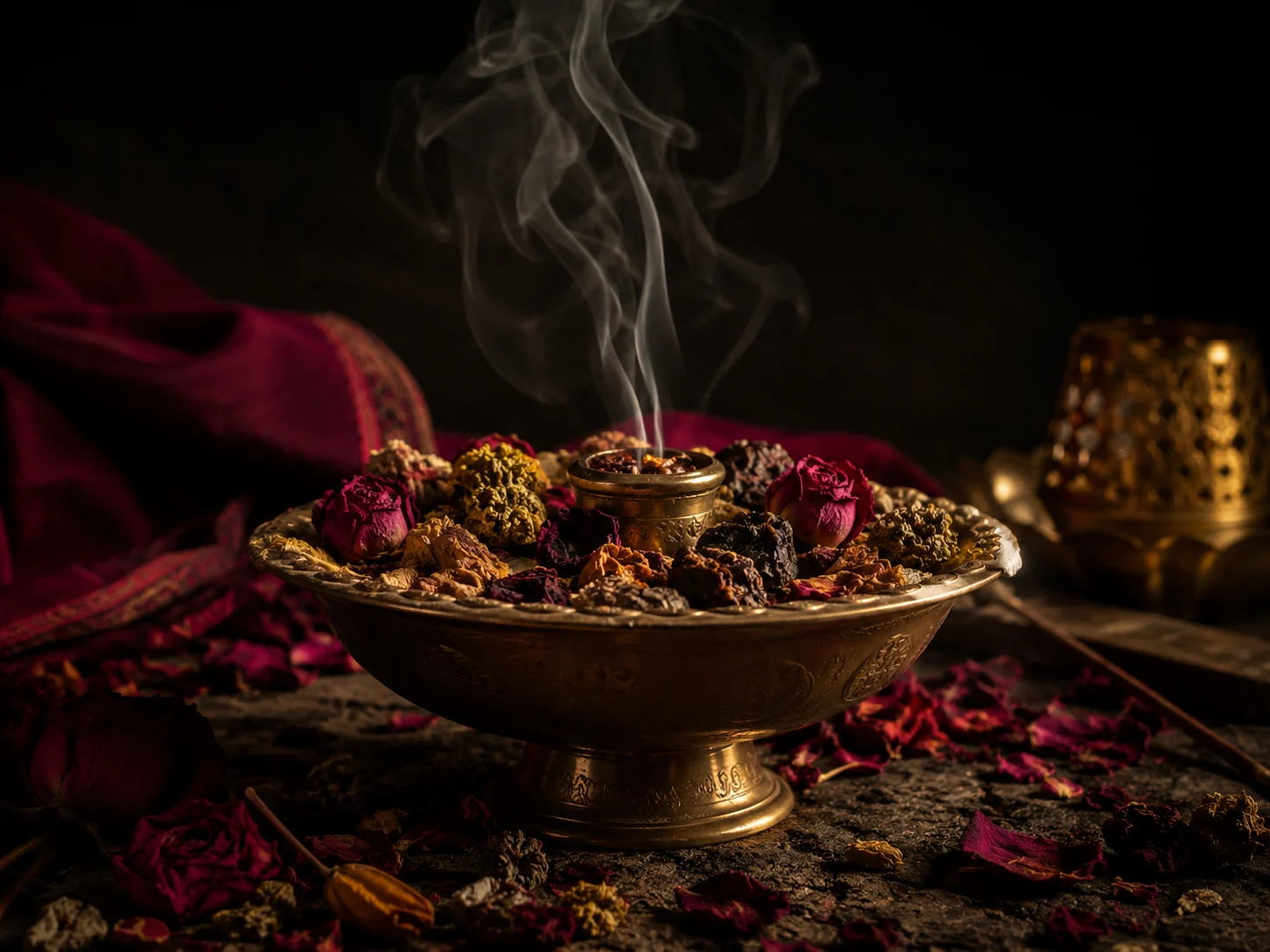
Botanicals, bowls, and sensory atmosphere
Botanicals and a brass bowl appear in the gallery as part of a quiet still-life setting. The image suggests care in preparing a space. It does not identify a universal recipe or make a claim that a particular plant is required for love magic. The actual role of any proposed botanical material needs to be explained.
Ask what the material is and what activity it is intended for. Do not assume that something shown beside a candle is meant to be burned, applied to skin, or consumed. A photograph cannot provide those instructions. If a service involves your handling of a material, the proposed use should be clear before you agree.
You can state relevant practical preferences without sharing an unnecessary medical history. For example, you may prefer an activity without smoke or fragrance. Ask whether the intention can be explored in a way that suits your setting. A consultation should make participation understandable and voluntary.
Crystals and personal associations
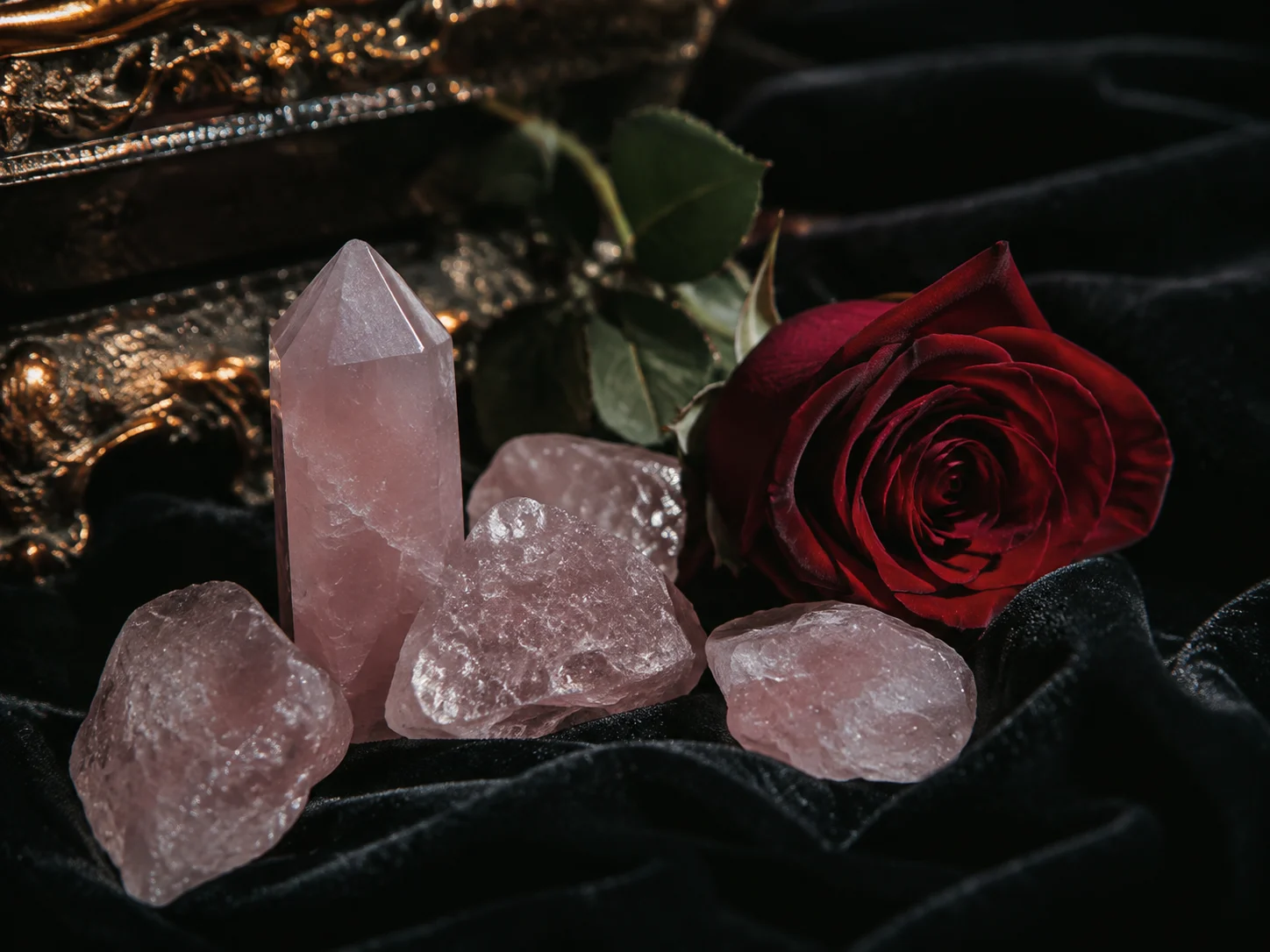
A piece of rose quartz appears in the artwork beside a rose. In this visual context, the combination suggests gentleness and reflection. It is not presented as a medical treatment, a measurement device, or proof of an influence over another person. An attractive object can carry personal meaning without those claims.
If a crystal is proposed as part of a service, ask what role it has in the practitioner's approach. Is it a symbolic reminder, an object used during the ritual, or something you would keep afterward? Clarify whether you are purchasing the item and whether an alternative is possible.
Price, size, and appearance should not be treated as automatic indicators of a more certain relationship result. A more expensive object does not establish a guaranteed reunion. The relevant information is the purpose of the material and the scope of the service you are agreeing to.

Envelopes and the meaning of privacy
A sealed envelope can suggest a thought held privately or an intention set aside for reflection. In the website imagery, it is a visual reminder that relationship questions can be personal. The seal is symbolic; it should not be confused with a technical guarantee about the privacy of an online message.
If you submit an inquiry through a website form, it is handled by the website's configured systems. A private-looking image does not turn an ordinary email workflow into a secure document vault. Read the privacy information and share only what is necessary for the initial conversation.
If a written intention will be kept by a practitioner, ask about its handling. You can request an explanation of whether it is retained, returned, or otherwise dealt with after the service. A clear practical answer helps you decide what information you are comfortable including.
Personal objects require a separate conversation
Some service descriptions may refer to photographs, letters, or belongings associated with a relationship. Do not assume that such objects are necessary. Ask what is being requested, why it is relevant, and how it will be handled. A general request for a consultation is not a reason to provide every personal item connected to a former partner.
Avoid sharing intimate images or material obtained from another person's private accounts. Do not take or use their belongings without permission. The wish to explore a spiritual intention does not remove another person's privacy or ownership of their possessions.
You can often begin by describing the situation without any object at all. If a proposal later includes an item, consider that request separately. You are allowed to ask questions or decline to provide something that makes you uncomfortable.
Understand whether materials are included in the cost
A service proposal should explain whether materials are included in the quoted amount or charged separately. Ask for the total proposed cost before agreeing. If a particular item is optional, have that stated clearly so you can decide whether it is something you want.
You can also ask what happens if the original proposal changes. A request for another item or an additional payment should come with an explanation. The absence of a relationship development does not automatically prove that a missing material needs to be purchased.
Keep the cost discussion connected to the service being delivered. You are considering a defined consultation or practice, not buying a verified change in another person's behavior. Clear wording makes it easier to understand what completion of the agreement will mean.
Do more materials mean a stronger service?
A larger number of objects can make an image look elaborate, but it does not establish a more reliable outcome. The meaning of a practice depends on the explanation and the intention within its context. Ask why each proposed item is included instead of assuming that more automatically means better.
A simple practice may be easier to understand and participate in than a complicated list of instructions. Complexity is not proof of authenticity, just as simplicity is not proof of a lack of meaning. The useful question is whether the proposal is clear and appropriate for the concern you brought.
If you are comparing services, look at scope, communication, costs, and expectations. Avoid comparing only the number of candles, the rarity of a botanical, or the visual intensity of a photograph. Those features do not tell you whether your questions will be answered clearly.
Questions to bring to a materials discussion
- What does each proposed material represent in this practice?
- Is the interpretation personal to the practitioner or connected to a specific tradition?
- Which items are required, and which are optional?
- Are materials included in the quoted total?
- Do I need to obtain or handle anything myself?
- Are alternatives available for activities involving smoke or fragrance?
- Will any personal object or written information be retained?
- What does completion of the agreed work include?
You can use these questions without needing to become an expert in ritual terminology. Their purpose is to help you understand the proposal. A respectful conversation can include practical clarification, personal preferences, and a decision not to proceed.
Keep the explanation with the agreement
If a material has a specific role in your proposed service, include that explanation in the written scope. This can be as simple as noting which items are supplied, which are optional, and whether anything will be returned afterward. The purpose is to keep your understanding aligned with the practitioner's description, not to turn a personal practice into a complicated inventory.
If you later receive an image of an arrangement, interpret it according to the agreement. A photograph may show an object or setting, but it cannot prove that another person's feelings changed. You can appreciate the image as part of the service while keeping claims about relationship outcomes separate. Ask questions about anything that differs from the proposal before assuming that a new material or additional payment is needed.
Frequently asked questions
Do the website images show the exact service materials?
No. They are symbolic artwork created for the website. Ask for the actual materials and their role to be explained in your individual proposal.
Can a candle color guarantee a particular result?
No. A color may have symbolic meaning in a practice, but it does not guarantee another person's feelings or a relationship outcome.
Must I buy rare or expensive objects?
Do not assume that you must. Ask why any item is proposed, whether it is optional, and how it affects the total cost. An expensive object is not evidence of a guaranteed result.
Should I send photographs of my ex in the first message?
Start with a brief description of your question. If a photograph is later requested, ask why it is needed and consider the other person's privacy. Never send intimate material or private account information.
Can I ask for a practice without smoke or open flames?
Yes. Explain your preference and ask what alternatives are available. The proposed participation should be clear and suitable for your circumstances before you agree.
How do I discuss materials with Baba Ali Musa?
Use the contact page to ask about the intention you are considering. The consultation can clarify scope, materials, costs, and follow-up. The service descriptions offer a starting point for those questions.
Visit the symbolic gallery, explore voodoo love spell consultations, or ask about a proposed practice.